


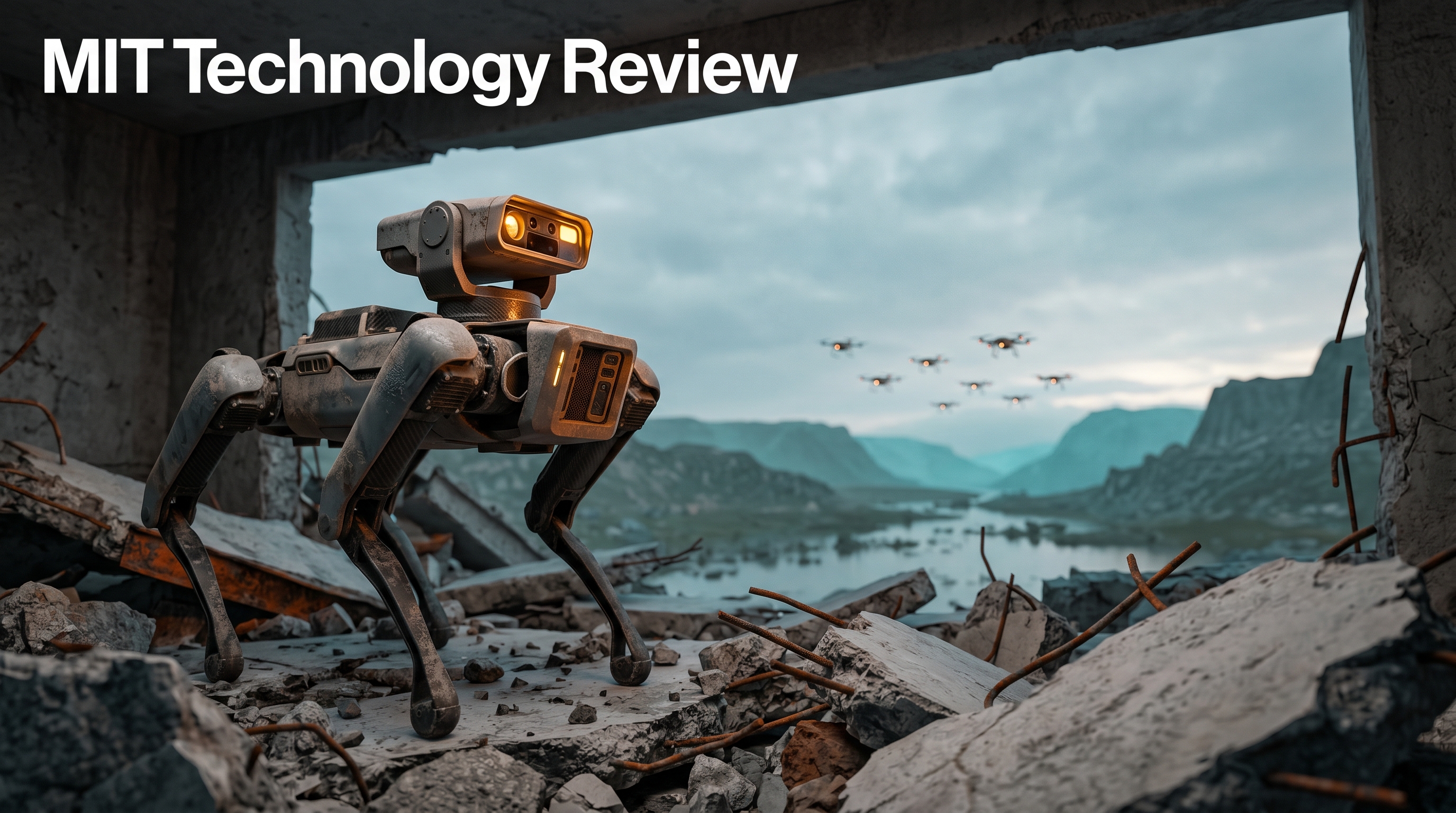
From Factories to Flood Zones: Why Robots Are Moving to the Front Lines
In 2022, factories worldwide were running on a record 3.9 million operational industrial robots, according to the International Federation of Robotics. That number is striking, but it mostly describes robots doing the same task, in the same controlled space, thousands of times a day. What's changed in the last decade is something more interesting: the underlying technologies, computer vision and autonomous navigation, are now capable enough to work in environments that don't cooperate. Flood zones don't look like assembly lines. Coral reefs don't hold still. Disaster rubble is, by definition, unpredictable.
The shift matters because the problems waiting outside the factory are enormous. Between 2000 and 2019, 7,348 recorded disaster events affected 4.2 billion people and caused roughly $2.97 trillion in economic losses, according to the UN Office for Disaster Risk Reduction. The IPCC's 2023 Synthesis Report concluded that human-caused climate change is already driving more frequent heatwaves and intensifying tropical cyclones. Meanwhile, the WHO projects a shortfall of 10 million health workers by 2030, concentrated in the countries least equipped to absorb the gap. These are not abstract policy problems; they are situations where physical, on-the-ground capacity is genuinely scarce.
That scarcity is exactly where "embodied AI" becomes relevant. Software alone can analyze a satellite image of a flooded city, but it cannot deliver insulin to a cut-off community or pull a sensor through a collapsed tunnel. Robots that combine physical mobility with real-time AI perception can do both. The technical term researchers use is "embodied AI": systems that perceive and act in the physical world rather than just processing data on a server. A drone that autonomously maps a fire front, adjusting its flight path as conditions change, is a different category of tool from a dashboard that shows you last hour's satellite data.
"Between 2000 and 2019, disasters affected 4.2 billion people and caused $2.97 trillion in losses. The factory floor was never the point."
The OECD AI Principles, adopted in 2019, explicitly connect AI development to "inclusive growth, sustainable development and well-being," and call for systems that are transparent and accountable. UNESCO's Recommendation on the Ethics of Artificial Intelligence, adopted by all 193 member states in 2021, urges that AI and robotic systems respect human rights, avoid harm, and support environmental sustainability. These aren't feel-good declarations. They're the international community's attempt to define what separates "AI for Good" from "AI for Good PR." The distinction matters more as robots move from controlled industrial settings into hospitals and disaster zones, where the consequences of a failure are measured in lives rather than production quotas.
None of this means the transition is smooth or inevitable. Industrial robots scaled because the economics were clear and the environment was controlled. Service robots, the category covering everything from hospital delivery bots to conservation drones, are scaling more slowly, partly because the environments are harder and partly because the governance frameworks are still catching up. The IFR tracks hundreds of thousands of professional service robot units sold annually across medical and public-environment applications, but "sold" and "successfully deployed at scale" are different things. The honest version of the "robotic heroes" story starts with acknowledging that the technology has left the factory but hasn't yet fully arrived at the flood zone. The sections below are about what happens in between.
Disaster Response: Where Robotic Heroes Earn the Name
The first recorded use of robots in urban search and rescue happened not in a laboratory demonstration but at Ground Zero. After the September 11, 2001 attacks, small ground robots and aerial drones were deployed at the World Trade Center site to inspect voids and assess structural conditions too dangerous for human entry. That moment, documented in disaster robotics research reviews, is where the "robotic hero" framing stopped being metaphorical. Twenty-plus years later, the deployments are more sophisticated and more frequent, though they're still running into many of the same barriers that existed in 2001.
Fukushima is the other landmark case. After the March 2011 nuclear disaster, robots were sent into reactor buildings where radiation levels would have been lethal to any human inspector within minutes. The robots weren't perfect; several broke down or got stuck in debris, which itself became a lesson in designing for genuinely hostile environments rather than controlled test conditions. But they inspected areas that would otherwise have remained unknown for years, and they did it without adding a single name to the casualty list.
"At Fukushima, robots entered reactor buildings where radiation would have been lethal to humans within minutes. Some got stuck. All of them still did more than any human could have."
The pattern established at those two events, aerial and ground robots providing situational awareness and inspection in environments too dangerous for human entry, has repeated across earthquakes in Turkey, Haiti, Italy, and Mexico in the two decades since. In the 2023 Türkiye-Syria earthquakes, aerial drones were widely used by responders to map damage and locate survivors across a disaster zone covering thousands of square kilometers. The speed advantage matters most in the first 72 hours, when the probability of finding survivors alive drops sharply. A drone can survey a collapsed city block in minutes; a human team on foot takes hours and risks aftershock injuries doing it.
What Disaster Robots Actually Do Well
It's worth being specific about where robots genuinely add value in disaster response, because the honest answer is narrower than the headline version. The strongest use cases cluster around two functions. First, situational awareness: aerial drones provide real-time imagery and thermal scanning that give incident commanders an accurate picture of a disaster zone far faster than ground teams can assemble one. Second, structural inspection: ground robots and drones can assess bridges and collapsed buildings for secondary hazards before human teams enter, reducing responder casualties. These are meaningful contributions, not marginal ones.
Robots with thermal cameras and acoustic sensors can also assist in locating survivors buried under rubble, detecting body heat or responding to sounds. Smaller ground robots can navigate gaps in debris that no human could fit through. In flood scenarios, surface drones have been used for post-event damage assessment and levee inspection, and in some pilot projects, for delivering small payloads to communities cut off by washed-out roads. None of this replaces a trained search-and-rescue team; it extends what that team can see and do in the critical early hours.
The Gap Between Prototype and Deployment
Here's the part that doesn't make the press release: the majority of disaster robots are still operating at research or pilot scale rather than as integrated national response systems. Interoperability is a real problem. A robot developed by one research group often can't share data formats with the incident command software a fire department uses. Training is another gap; operating a robot in a dynamic disaster environment requires skills that most first responders don't currently have, and building that capacity takes years of investment, not a product launch.
There's also a dual-use concern that deserves more attention than it typically gets. The same drone that maps a flood zone for rescue teams is technically identical to one used for surveillance or border enforcement. In communities that have experienced aggressive policing or military occupation, the appearance of drones overhead during a crisis can erode trust rather than build it, even when the intent is purely humanitarian. This isn't a hypothetical; humanitarian organizations working in conflict-adjacent disaster zones have documented exactly this dynamic. How it's governed and how communities are consulted about its use shapes whether a "robotic hero" is received as help or as threat.
Robots in the Ward: Pandemics and the 10-Million Worker Gap
Start with a number that should make health ministers sweat: the WHO projects a shortfall of 10 million health workers by 2030, concentrated heavily in low- and lower-middle-income countries. Now layer on UN DESA projections that the number of people aged 65 and older will roughly double from 761 million in 2021 to 1.6 billion by 2050. More older patients, fewer workers to care for them. Robots aren't a magic fix for that equation, but they're one of the few tools that can be in two wards simultaneously without filing for overtime.
COVID-19 turned that abstract workforce argument into an urgent operational one. A widely cited 2020 paper in Science Robotics outlined how robots could help mitigate pandemic conditions across clinical care and internal logistics. In practice, hospitals deployed telepresence robots for remote consultations, cutting the number of direct contacts between infected patients and clinical staff. Autonomous UV-C disinfection robots ran overnight circuits through wards and public spaces, reducing viral load without requiring a human to enter a contaminated room. Logistics robots delivered medications and meals inside hospitals, freeing nursing staff from supply runs during the periods when staff-to-patient ratios were most strained.
"COVID-19 didn't create healthcare robotics, but it stress-tested it in ways that five years of conference presentations never could."
Most of those COVID-era deployments were pilot-scale or improvised rather than part of pre-planned integrated systems. That's actually a useful data point. It suggests the technology was mature enough to be rapidly repurposed under crisis conditions, but that health systems hadn't invested in the infrastructure and procurement pathways needed to use it at scale. The lesson isn't that robots failed during COVID; it's that the lack of preparedness limited how much they could help. Building that preparedness now, before the next pandemic or the next demographic crunch, is the more productive conversation.
Where the Surgical Evidence Gets Complicated
Outside of pandemic response, surgical robotics has become a genuine part of mainstream medicine in high-income settings. Robotic-assisted laparoscopic procedures are now routine in many hospitals, with studies showing benefits including smaller incisions and shorter hospital stays for certain procedure types, though the evidence varies considerably by specialty and patient population. This is not a field where you can make a blanket claim that "robotic surgery is better"; the honest answer is that it's better for some procedures, roughly equivalent for others, and significantly more expensive across the board, which raises real access questions.
Rehabilitation robots, including exoskeletons and robotic gait trainers, are being used in hospitals and specialist centers to support recovery after stroke and spinal injury. Clinical studies show improvements in mobility and motor function for some patient groups, though systematic reviews note that effect sizes vary and long-term outcomes need more research. Social and assistive robots for older adults and children in autism therapy are at an earlier stage; systematic reviews report mixed but promising results, with researchers consistently emphasizing that these tools need to support human relationships rather than substitute for them. A robot that reminds an elderly person to take their medication is a useful tool. A robot that becomes their primary source of social interaction because care staffing is too thin is a different situation entirely, and not a good one.
Who Benefits, and Who Gets Left Behind
The equity problem in healthcare robotics is straightforward to state and genuinely hard to solve. Advanced surgical and rehabilitation robots are expensive to buy and operate. They've been developed primarily in and for high-income health systems, which means the innovation pipeline is oriented toward problems those systems face. The WHO's projected 10-million worker shortfall is concentrated in lower-income countries, but the robots being built to address workforce gaps are mostly being sold to hospitals in wealthy ones.
This isn't an argument against developing healthcare robots. It's an argument for being clear-eyed about who the current generation of tools actually serves. Telepresence robots and lower-cost autonomous disinfection units have more plausible near-term applications in resource-constrained settings than a $2 million surgical system. Some researchers and global health organizations are explicitly working on this, designing simpler, more durable robotic tools for primary care and community health contexts in lower-income countries. That work deserves more attention and more funding than it currently gets, because the 10-million worker gap isn't going to be solved by equipping hospitals in Boston and Berlin.
Feeding 10 Billion People With a Little Help From Machines
In 2022, roughly 735 million people faced chronic hunger, according to the FAO's State of Food Security and Nutrition in the World 2023 report. That figure was already about 122 million higher than in 2019, before COVID-19 and a cascade of supply chain disruptions pushed the number upward. At the same time, the FAO projects that feeding a global population approaching 10 billion by 2050 will require substantially higher food production while simultaneously reducing the environmental footprint of agriculture: less water, fewer chemicals, lower greenhouse gas emissions. Growing more food with less of everything is not a slogan; it's an engineering problem. And it turns out robots are reasonably good at engineering problems.
The core contribution of AI-enabled agricultural robots isn't replacing farmers; it's making inputs more precise. Conventional farming applies fertilizer and pesticide at field scale, which means the plants that need less get too much and the ones that need more don't get enough. Drones and ground robots equipped with multispectral imaging can monitor crop health at the individual plant level, identifying nutrient deficiency or disease stress before it becomes visible to the human eye. That data feeds into targeted irrigation and fertilizer systems that apply inputs only where needed, cutting waste and reducing the runoff that degrades waterways downstream. The efficiency gains are context-dependent, but the direction of the effect is consistent across peer-reviewed agronomy research.
"Vision-guided weeding robots can cut herbicide use by 50% or more in controlled studies. The planet's waterways would like to see that scaled up considerably."
Weeding is one of the more compelling specific cases. Field robots that mechanically remove weeds or apply micro-doses of herbicide directly to individual plants, rather than broadcasting chemicals across an entire field, have shown herbicide reductions of 50% or more in controlled studies. That matters both economically, since herbicide is a significant input cost, and environmentally, since chemical runoff is a major contributor to freshwater and coastal ecosystem degradation. Commercial systems are still evolving and not yet widely affordable for smallholder farmers, but the trajectory of cost reduction in agricultural robotics broadly mirrors what happened with industrial robots over the past two decades.
Harvest Robots and the Labor Question
Fruit and vegetable harvesting is where agricultural robotics gets genuinely complicated. Picking a ripe strawberry without bruising it, or identifying a ready cucumber hidden under leaves, requires the kind of dexterous manipulation and visual judgment that robots have historically struggled with. Recent advances in computer vision and soft robotics, grippers that can handle delicate produce without crushing it, have brought harvesting robots closer to commercial viability for some high-value crops. Several companies are running trials in strawberry and apple orchards, with mixed results depending on crop variety and growing system.
The labor dimension deserves a direct look rather than a polite sidestep. Agricultural harvesting in many countries depends heavily on seasonal migrant workers, often in conditions that are physically grueling and poorly compensated. Proponents of harvest robots argue that automation addresses genuine labor shortages and reduces dependence on exploitative labor arrangements. Critics point out that displacing low-wage workers without providing alternative livelihoods transfers the problem rather than solving it. Both things can be true simultaneously. The technology itself doesn't resolve that tension; policy does. What robots can do is create the conditions where that policy conversation becomes unavoidable, which is either an opportunity or a warning depending on who's at the table when decisions get made.
Teaching the Next Generation to Build These Tools
One of the more quietly significant developments in agricultural robotics is happening in classrooms rather than fields. In 2025, FAO and the ITU launched the second edition of the Robotics for Good Youth Challenge, inviting participants aged 12 to 18 worldwide to design and build robots addressing global food insecurity. The challenge runs under the UN's AI for Good initiative and is explicitly framed around the SDGs and agrifood systems.
Previous editions have produced regional events where student teams built working robots for agriculture and disaster scenarios. Sixty teams from across India showcased their work at one regional event, and Nigeria hosted its own regional competition, with students designing robots to address local food system challenges. The UNRIC has highlighted the challenge as part of a broader push to make AI and robotics education participatory and geographically inclusive. That framing matters. The food security problem is most acute in sub-Saharan Africa and South Asia; having young people from those regions building the tools to address it is a different proposition from having Silicon Valley design solutions for farmers they've never met.
Planetary Guardians: Robots Watching Over Climate and Wildlife
The World Meteorological Organization's State of the Global Climate 2023 report documented a year of record-breaking extremes: the hottest global average temperatures ever recorded, unprecedented Antarctic sea ice loss, and ocean heat content reaching new highs. The IPCC's 2023 Synthesis Report was blunter still, concluding that human-caused climate change is already causing widespread adverse impacts, with heavier rainfall and more intense tropical cyclones becoming the new baseline. Monitoring all of this, in real time, across the full surface of a planet, is a data collection problem of staggering scale. Robots are increasingly part of how scientists and agencies are attempting to solve it.
The ocean is where autonomous vehicles have arguably made the biggest contribution to climate science so far. Uncrewed surface vessels and underwater gliders, guided by AI navigation systems, collect high-resolution data on sea surface temperatures and atmospheric conditions that feed directly into the weather and climate models used by agencies including NOAA and the WMO. The practical advantage over crewed research vessels isn't just cost; these systems can operate in conditions that would be dangerous or impossible for human crews, including inside developing hurricanes, where the atmospheric data is most valuable and most scarce. A drone that can fly into a Category 4 storm and transmit real-time pressure and wind measurements is providing information that no weather balloon or satellite pass can fully replicate.
"An autonomous drone can fly into a Category 4 hurricane and transmit real-time data. The alternative is a crewed aircraft doing the same thing, which is exactly as alarming as it sounds."
Wildfire management is another area where aerial robots have moved from experimental to operationally useful. Firefighting agencies in the western United States and southern Europe have increasingly used thermal-camera drones to map active fire fronts, detect hotspots hidden under smoke, and assess risks to communities in a fire's path. The speed advantage is significant: a drone can survey terrain in minutes that would take ground crews hours to reach, and it can do so without putting anyone in the path of a wind shift. The data feeds into incident command decisions about where to position crews and equipment, which is exactly the kind of situational awareness that disaster robotics researchers have been arguing for since the early 2000s.
Underwater and Into the Wild
Conservation biology has quietly become one of the more active fields for robotics deployment. Underwater robots equipped with machine vision systems survey coral reefs and fish populations, identifying species and tracking reef health across areas that human divers could never cover at the required frequency. Coral reef monitoring is particularly time-sensitive; bleaching events can develop and spread within weeks, and early detection allows conservation managers to prioritize intervention resources. A robot that can complete a standardized reef survey in a fraction of the time and cost of a human dive team makes that kind of monitoring feasible at scale rather than just at selected research sites.
Anti-poaching and illegal fishing enforcement represent a different application of the same basic technology. Aerial drones are being used in protected wildlife reserves and marine protected areas to detect unauthorized activity and extend the effective range of ranger patrols that are chronically understaffed relative to the areas they're supposed to cover. In large marine reserves, surface drones can monitor vessel activity across hundreds of square kilometers, flagging suspicious behavior for human follow-up. The technology doesn't replace enforcement capacity; it multiplies the reach of the human capacity that exists.
The Surveillance Problem, Again
Environmental robotics runs into the same dual-use tension that appears in disaster response. Drones that monitor wildlife poaching in a national park are functionally identical to ones used for border surveillance or tracking the movements of indigenous communities whose land overlaps with a protected area. Several conservation organizations have faced criticism for deploying aerial monitoring in ways that communities experienced as invasive rather than protective, particularly where those communities have historically been displaced or excluded in the name of conservation. The technology is neutral on this question. Whether a drone deployment respects community rights or violates them depends entirely on who controls it and whether affected people had any say in its use. That's not a technical specification; it's a governance choice, and it applies as much to a conservation drone over a Kenyan savanna as to a disaster robot over a flood-hit city.
Who Gets to Build the Next Generation of Robotic Heroes?
The geography of robotics research and development is not evenly distributed. The overwhelming majority of advanced robotics work, the patents, the venture funding, the university research programs, originates in a handful of countries: the United States, Japan, South Korea, Germany, and China. That concentration matters because the problems that "AI for Good" robotics is supposed to address are most acute elsewhere. The communities dealing with the worst food insecurity, the most frequent climate disasters, and the largest healthcare workforce gaps are largely not the communities designing the tools meant to help them. That's a design problem as much as a funding problem.
This is the context that makes initiatives like the FAO and ITU's Robotics for Good Youth Challenge genuinely interesting rather than just feel-good. Launched in its second edition in 2025, the challenge invites young people aged 12 to 18 from around the world to design and build robots addressing global food insecurity, framed explicitly within the UN's AI for Good initiative and the SDGs. The geographic reach is the point. This isn't a competition for students at well-resourced private schools in wealthy countries, though they participate too. It's structured to include participants from regions where the food security problem is immediate and personal, not abstract.
"If the people most affected by food insecurity aren't in the room where agricultural robots get designed, don't be surprised when the resulting tools don't quite fit their farms."
The regional events tell the story concretely. Sixty teams from across India recently showcased robots they'd designed and built, demonstrating both technical skill and familiarity with local agricultural conditions. Nigeria hosted its own regional competition, with student teams working on solutions relevant to West African food systems. The Opportune Foundation in Australia has highlighted the challenge as an opportunity for young people to engage with real global problems through hands-on engineering. These aren't science fair projects in the dismissive sense; they're structured design challenges built around actual SDG targets, with mentorship from FAO and ITU technical staff.
Why Participation Matters Beyond the Competition
There's a longer-term argument here that goes beyond any single challenge. The students who compete in events like this are building intuitions about what problems are worth solving and what constraints actually matter in the field. A teenager in rural Nigeria who designs a crop-monitoring robot for smallholder farms is working with a completely different set of constraints than an engineering student in Tokyo or Stanford: lower cost ceilings, less reliable power infrastructure, different crop varieties, different soil conditions. Those constraints, if they shape the design process from the start, produce different and often more practically useful tools than solutions designed in wealthy contexts and then "adapted" for lower-income ones.
The UNRIC has framed the challenge as part of a broader effort to democratize who participates in AI and robotics development, not just who consumes the resulting products. That framing aligns with what the UNESCO Recommendation on the Ethics of Artificial Intelligence calls for: AI development that is inclusive, respects human rights, and avoids concentrating its benefits among those already advantaged. It's one thing to write that into a 193-nation declaration. It's another to actually fund and run programs that put robotics tools and mentorship in front of young people in Lagos and Chennai rather than exclusively in Palo Alto.
The Structural Question Underneath All of This
Participation initiatives are valuable, but they operate within a larger structural reality. Robotics hardware is expensive to manufacture and distribute. Maintenance requires supply chains and technical expertise that are unevenly available globally. Even if a brilliant team of students in sub-Saharan Africa designs an excellent agricultural robot, getting it from prototype to deployed product requires capital and distribution infrastructure that remains concentrated in a small number of countries and companies.
Some researchers and development organizations are working explicitly on this, designing low-cost, repairable robotic platforms for agricultural and health applications in resource-constrained settings, and building local technical capacity alongside the hardware. That approach, prioritizing repairability and local ownership over cutting-edge specifications, is less glamorous than announcing a new AI model but probably more useful in the contexts that need it most. The OECD AI Principles call for AI that promotes "inclusive growth" rather than concentrating benefits among those already advantaged. Applying that principle to robotics means asking, at every stage of development and deployment, whether the design choices being made are widening or narrowing the gap between who has access to these tools and who doesn't.
The Honest Reckoning: Limits, Risks, and the Governance Gap
"AI for Good" is a real initiative, run by the ITU, with real programs and real participants. It is also, unavoidably, a phrase that sounds like a marketing tagline. Both things are true, and the tension between them is worth sitting with before arriving at any tidy conclusions about robotic heroes. The same technologies documented throughout this post, drones, autonomous ground vehicles, AI-guided sensors, have military applications and labor displacement applications that are at least as well-funded as their humanitarian counterparts. Acknowledging that isn't pessimism; it's the minimum required for an honest assessment.
The dual-use problem is structural, not incidental. A drone designed for coral reef monitoring is aerodynamically identical to one used for border surveillance. A ground robot built for post-earthquake search and rescue uses the same navigation algorithms as one deployed for perimeter security. The UNESCO Recommendation on the Ethics of Artificial Intelligence, adopted by 193 member states in 2021, explicitly urges that AI systems avoid military misuse and mass surveillance, and calls for environmental sustainability and human rights protection. That's a meaningful statement of values. It is not, however, a binding enforcement mechanism, and the countries most actively developing military robotics are among the signatories.
"The drone that maps a flood zone for rescue teams is technically identical to one used for border enforcement. The difference is entirely in who controls it and under what rules, which is to say, the difference is entirely political."
The OECD AI Principles call for AI systems to be transparent and accountable, with human oversight mechanisms that allow for correction when things go wrong. Applied to physical robots operating in high-stakes environments, those principles raise questions that are currently more open than resolved. Who is legally liable when an autonomous search-and-rescue robot makes a wrong decision in a disaster zone? What standards govern the data collected by conservation drones over indigenous territories? How should communities affected by robotic deployments be consulted before, not after, those deployments happen? These aren't hypothetical edge cases; they're operational questions that current governance frameworks handle inconsistently at best.
The Prototype-to-Scale Problem
A recurring theme across every domain covered in this post is the gap between a successful pilot and a functioning system. Disaster robots have been deployed in dozens of events since 2001, but most countries still lack integrated national frameworks for incorporating them into incident command structures. Agricultural robots have shown impressive results in controlled trials, but commercial availability and affordability for smallholder farmers remain limited. Healthcare robots proved their value during COVID-19 deployments, but health systems mostly weren't prepared to use them at scale and still aren't. Pilots are not the same as infrastructure, and the robotics field has a habit of celebrating the former while understating how much work separates it from the latter.
Part of the problem is funding structure. Research grants and venture capital both favor novelty: building a new robot, demonstrating a new capability, publishing a new result. The less glamorous work of integration, training human operators, building maintenance supply chains, and developing interoperability standards, attracts less money and less attention. This isn't a criticism of researchers or investors individually; it's a description of incentive structures that systematically underinvest in the last mile between prototype and deployment.
Automation, Labor, and Who Actually Pays
The labor displacement question deserves more direct treatment than it usually gets in "AI for Good" coverage. Agricultural robots that reduce the need for seasonal harvest workers, logistics robots that replace hospital supply staff, autonomous systems that take over tasks previously done by lower-wage workers in lower-income countries: these are real effects, not hypothetical ones. The IFR's data on industrial robot adoption already shows concentrated deployment in manufacturing sectors that previously employed large numbers of lower-skilled workers. The expansion of robotics into agriculture and healthcare logistics will extend that dynamic into new sectors.
None of this means robotic deployment in these domains is net negative. A robot that takes over the most physically dangerous parts of disaster response genuinely reduces human risk. A disinfection robot that runs overnight circuits in a hospital ward frees nursing staff for direct patient care rather than eliminating nursing jobs. The effects are sector-specific and depend heavily on how deployment is managed and what support structures exist for workers whose roles change. But the "AI for Good" framing can obscure these tradeoffs if it treats automation as straightforwardly beneficial without accounting for distributional effects. Who captures the productivity gains from agricultural robots? Who bears the cost of the transition? Those questions don't have technical answers. They have political ones, and pretending otherwise is where "AI for Good" slides from inspiring into solutionist.
What "AI for Good" Actually Requires
The evidence assembled across this post points in two directions simultaneously, and it's worth resisting the urge to resolve that tension too quickly. On one side: robots have genuinely saved lives in disaster zones, meaningfully extended the reach of conservation monitoring, demonstrated real potential to reduce chemical inputs in agriculture, and helped health systems cope with conditions, like a global pandemic, that would have been even worse without them. On the other side: most deployments are still pilot-scale, governance frameworks lag badly behind technical capability, the benefits are distributed unequally, and the same technologies enabling "robotic heroes" are being actively developed for surveillance and warfare by many of the same actors funding the humanitarian applications.
Holding both of those things in view at once is not fence-sitting. It's the only intellectually honest position available, and it's the one that the international frameworks themselves take. The OECD AI Principles don't say AI is good; they say AI can support inclusive growth and sustainable development when it operates with transparency and genuine human oversight. The UNESCO Recommendation on the Ethics of Artificial Intelligence doesn't celebrate AI; it establishes conditions under which AI systems respect human rights and avoid harm. The conditionality is the point. "AI for Good" is a description of a set of choices, not a property of the technology itself.
"'AI for Good' is not a feature of the technology. It is a description of choices made by the people who fund it and deploy it. Change the choices, change the outcome."
From Principles to Practice
The gap between stated principles and operational practice is where most of the real work sits. Consider what "transparency and accountability" actually means for a search-and-rescue robot operating in a disaster zone: it means clear protocols for who authorizes deployment, what data the robot collects and who has access to it, how errors or malfunctions are reported, and what recourse communities have if a deployment causes harm rather than preventing it. None of that is technically complicated. All of it requires institutional investment and legal frameworks, plus the kind of unglamorous standard-setting work that doesn't generate headlines. The UNDRR's data on disaster losses makes a compelling case for investing in better response tools; it doesn't automatically fund the governance infrastructure those tools require.
The same logic applies in healthcare. Surgical robots and rehabilitation systems operating in clinical settings are subject to medical device regulation, which provides at least some framework for safety and accountability. But as AI-driven robotic systems move into community care and lower-income health settings, the regulatory frameworks become patchier. A social robot deployed in a care home for older adults is collecting data about vulnerable people in their most private moments. Who owns that data, what it can be used for, and whether residents meaningfully consented to its collection are questions that current regulations in most countries answer poorly if at all.
The Concrete Asks
If you've read this far and want to move from interested observer to active participant, the entry points are more accessible than the scale of the problems might suggest. The AI for Good Robotics for Good Youth Challenge is one concrete channel: supporting young people in your community to participate, or supporting organizations like the Opportune Foundation that help connect students to these opportunities, puts resources into exactly the kind of participatory, geographically distributed development pipeline that the field needs more of.
For small business owners specifically, the relevant question is less "how do I deploy a robot" and more "what choices am I making when I adopt AI-enabled tools in my own operations?" The same principles that apply to planetary-scale robotics apply at the scale of a small business: Is the system I'm using transparent about how it makes decisions? Do the people affected by it, employees, customers, suppliers, have meaningful recourse if it produces a bad outcome? Am I capturing the productivity benefit while someone else bears the cost of the transition? These aren't rhetorical questions. They're the operational version of what the OECD and UNESCO are asking at the international level, scaled down to a size where individual choices actually matter.
The Fukushima inspection robots entered reactor buildings that would have stayed unmapped for years otherwise; someone had to decide to send them in, define the data protocols, and accept liability for the mission. Conservation drones extending ranger patrols across marine reserves only work when the rangers themselves are trained to use the footage and the communities being monitored have been consulted. Student teams in Lagos and Chennai building agricultural robots shaped by the constraints of farms they actually know are doing something that a Silicon Valley accelerator cannot replicate by writing a check. In each case, the hardware is the easy part. The authorization protocols, the training investment, the community consent processes, the accountability when something goes wrong: that is where "AI for Good" either earns the name or doesn't.
Sources
Robotics for Good Youth Challenge, ITU AI for Good, the official UN initiative page outlining the challenge structure, eligibility, and SDG framing.
FAO and ITU launch Robotics for Good Youth Challenge 2025 to 2026, the FAO press release announcing the second edition of the challenge and its focus on global food insecurity.
Robotics for Good Youth Challenge 2025 to 2026, UN Regional Information Centre for Western Europe, UNRIC's coverage of the challenge as part of the broader push to democratize AI and robotics education globally.
Robotics for Good Youth Challenge, Opportune Foundation, an independent foundation resource connecting young participants to the challenge and summarizing entry requirements.
60 teams from across India at the Robotics for Good regional event, AI for Good, video documentation of the India regional competition showcasing student-built robots.
Robotics for Good Youth Challenge Nigeria, YouTube, footage from the Nigeria regional competition, with student teams designing robots for local food system challenges.
Robotics for Good Youth Challenge, YouTube, video overview of the challenge format, mission structure, and participant experience.
Robotics for Good, YouTube playlist, ITU AI for Good, a full playlist of Robotics for Good videos documenting competitions, regional events, and participant projects across multiple editions.
.svg)