


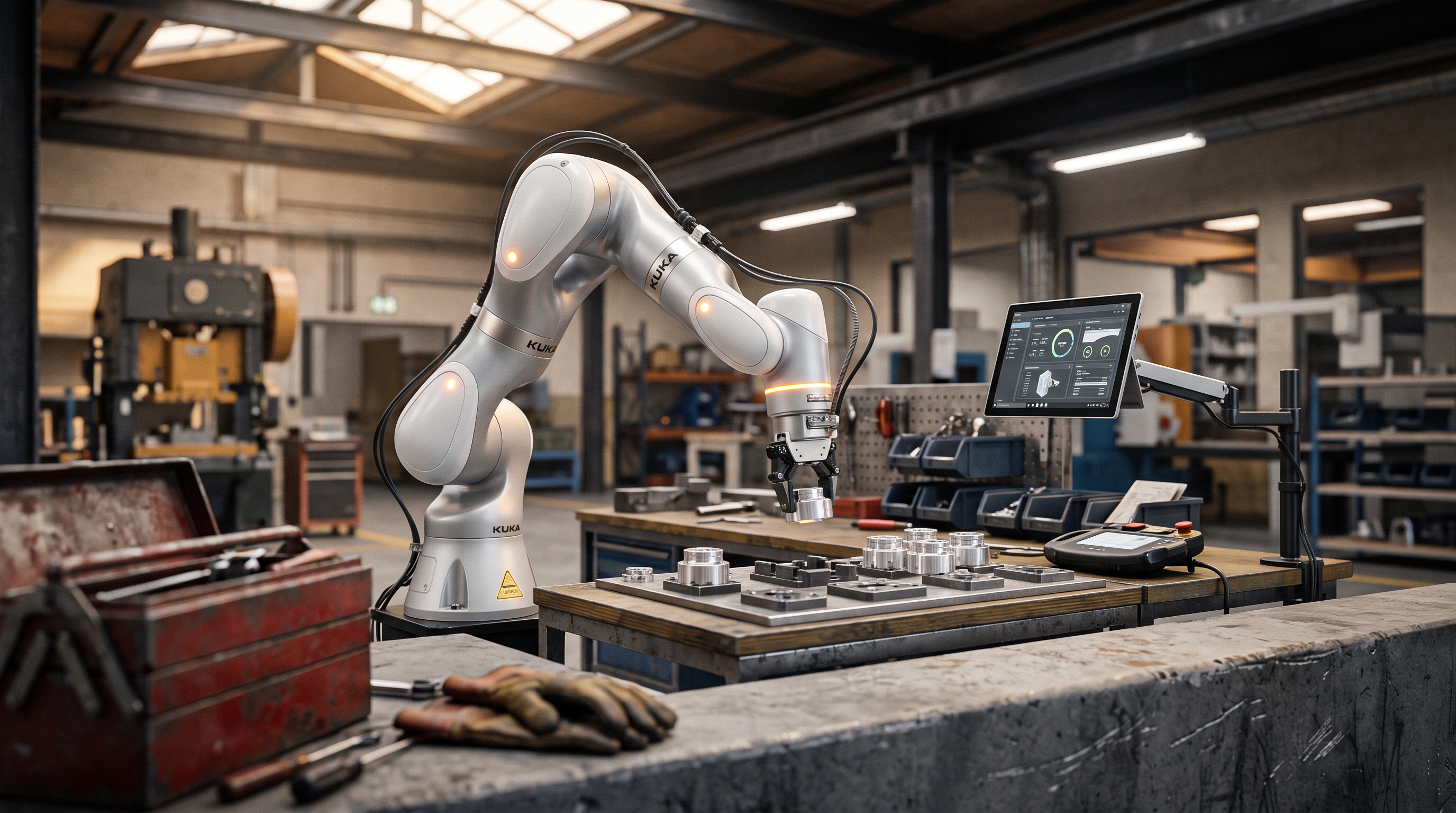
The Robot in the Room: Why Small Factories Keep Stalling on Cobots
Somewhere around 2022, "cobot" became the word every manufacturing consultant dropped into every slide deck. The pitch was irresistible: a friendly robot arm that works right next to your people, doesn't need a safety cage the size of a studio apartment, and costs a fraction of a traditional industrial robot. According to a Grand View Research forecast, the global collaborative robot market is projected to expand from roughly USD 2.8 billion in 2026 to USD 10.9 billion by 2033, a compound annual growth rate of about 21.4%. That is a lot of robot arms. So why does the average small factory owner still look mildly panicked when the subject comes up?
The honest answer is that the gap between "cobots are affordable and flexible" and "cobots are actually running on my floor making me money" is wider than the brochures suggest. A MIT Sloan Management Review piece on cobots in smaller firms put it plainly: integration, not the robot hardware itself, is the primary barrier to adoption for small and medium-sized manufacturers. The robot is almost the easy part. It's everything around the robot that will cost you sleep.
Small manufacturers face a specific set of structural disadvantages that larger plants simply don't deal with at the same scale. A 2021 master's thesis examining cobot adoption in manufacturing SMEs found that small firms typically operate with small lot sizes, constrained floor space, and a near-total absence of in-house robotics expertise. Traditional industrial robots were already a bad fit for those conditions; they're expensive, inflexible, and need dedicated space and specialist programmers. Cobots were supposed to fix all of that. And they do fix some of it. Just not enough of it, and not automatically.
The market forecasts are genuinely impressive on paper. One industry estimate cited in a July 2024 cobot workplace study projects U.S. cobot market growth at a CAGR of 29.9% between 2023 and 2030, with global growth running at 32.0% over the same period. Those numbers describe an industry in serious acceleration. But aggregate market growth figures can obscure a lot of friction at the individual company level. A category can be booming while a significant slice of its target customers remain stuck on the sidelines, watching the boom from a safe distance.
"The robot is almost the easy part. It's everything around the robot that will cost you sleep."
What keeps small factory owners on those sidelines is rarely one catastrophic objection. It's a cluster of smaller, interlocking problems that compound each other. The cost question alone is more complicated than it looks: a 2025 analysis of the collaborative robotics market puts typical cobot hardware costs between USD 20,000 and USD 40,000, with payback periods estimated somewhere between 12 and 30 months, though those figures are aggregated across industries and production volumes that vary enormously. A shop running high-mix, low-volume orders on tight margins is going to have a very different payback experience than the factory those numbers were modeled on.
There's also a confidence problem that doesn't show up in market research reports. Many small manufacturers have watched a peer or a supplier attempt a cobot installation and quietly fail, either because the integration took far longer than expected, or the system needed constant tweaking, or the workforce resisted it in ways nobody planned for. That kind of secondhand experience is hard to quantify but very effective at killing enthusiasm. The cobot market may be growing at 21% annually, but the small factory owner who watched their neighbor's robot collect dust for six months is not going to be swayed by a CAGR.
The result is a peculiar kind of stalemate. The technology has genuinely improved. Prices have come down. The use cases are well documented. And yet a large portion of the manufacturers who could benefit most from cobots, the small shops with repetitive tasks, worker shortages, and no appetite for the cost of hiring specialists, are still waiting. They're not wrong to be cautious. They're responding rationally to a set of real barriers that the industry has been slow to dismantle. The rest of this piece is about whether that's finally starting to change.
Integration Is the Real Monster, Not the Machine
Here is a number that should make any small business owner put down their coffee: according to robotics researcher Julie Shah, as cited in a MIT Sloan Management Review analysis of cobot adoption, the cost of the robot hardware itself is only a small fraction of what you'll actually spend. Integration, meaning the work of connecting the robot to your actual workflow, your conveyors, your vision systems, your software, your people, typically costs four to five times the price of the robot. So that USD 30,000 cobot you budgeted for? Budget for USD 150,000 in total, and then add a buffer for the surprises.
This is not a niche problem or an edge case. It's the central economic reality of cobot deployment for small manufacturers, and it's the reason why the hardware price dropping over the past decade hasn't automatically translated into mass adoption among smaller shops. The machine getting cheaper is great. The machine getting cheaper while everything required to make it useful stays expensive is a much more complicated story. Shah's framing is worth sitting with: the robot is almost incidental to the actual cost of automation. What you're really buying is an integration project that happens to include a robot arm.
The Standardization Problem Nobody Talks About in the Sales Pitch
One of the less glamorous reasons integration is so expensive is that the cobot industry, despite two decades of growth, still lacks meaningful standardization across hardware and software. The MIT Sloan piece flags this directly: each robot system tends to require its own specific knowledge base, its own programming language, and its own connector ecosystem. If you've already integrated one brand of cobot and you want to add a different one, or swap out a peripheral, you're often starting from scratch. For a large manufacturer with a dedicated robotics engineering team, that's annoying. For a 40-person machine shop, it's potentially a project-killer.
The NIST best-practices report on integrating collaborative robots for small and medium manufacturers gets even more specific about where this fragmentation bites. Vision systems are a recurring pain point: reprogramming them between product batches is time-consuming enough that it can eat into the productivity gains the cobot was supposed to deliver. Transitions between batch types often require extensive reconfiguration. And many cobot systems simply aren't adaptable to a wide enough variety of workcell configurations to handle the kind of high-mix production that defines small factory work. The robot is flexible. The ecosystem around it frequently isn't.
When You Can't Afford the Expert and Can't Afford Not to Have One
The NIST report also identifies something that doesn't get nearly enough attention in cobot marketing: the severe shortage of accessible, unbiased guidance for small manufacturers making integration decisions. NIST's guidance document lists a lack of unbiased advice on investment decisions as a major obstacle, sitting right alongside the more obvious technical barriers. Most of the detailed information available to a small factory owner comes from vendors, distributors, or system integrators who have a financial stake in the outcome. Independent, practical guidance is genuinely hard to find.
System integrators, the specialists who actually do the work of connecting robots to production lines, are in short supply and tend to cluster around larger industrial clients where the contracts are bigger. NIST notes that many small manufacturers either can't afford experienced integrators or can't find ones willing to take on a smaller project. That leaves self-integration as the default option for a lot of small shops, which is manageable if your team has some technical depth, and genuinely risky if it doesn't. The irony is that the manufacturers who most need outside help are the ones least likely to be able to access it.
"That USD 30,000 cobot you budgeted for? Budget for USD 150,000 in total, and then add a buffer for the surprises."
What makes this particularly frustrating from a policy and industry perspective is that the barriers aren't mysterious. They've been documented by NIST, analyzed in academic research, and flagged repeatedly by independent observers. The 2021 SME cobot thesis found that knowledge gaps, poor awareness of Industry 4.0 technologies, and difficulty finding reliable information were central challenges, not peripheral ones. A Korean study cited in that thesis found small firms struggling to build smart factory capabilities specifically because of a lack of experienced personnel and access to relevant expertise. These aren't problems that a better robot solves on its own.
The integration problem is, at its core, a services and knowledge problem wearing a technology costume. The robot hardware has improved substantially over the past decade. The surrounding infrastructure, the training resources, the standardized software tools, the accessible expert networks, has not kept pace. Until that gap closes, the four-to-five times multiplier on integration costs isn't going anywhere, and neither are the small manufacturers sitting on the sidelines trying to figure out if the math will ever work for them.
The Skills Gap Nobody Warned You About
The cobot industry has spent considerable energy making robots easier to program. Graphical interfaces replaced command-line code. Drag-and-drop logic replaced scripting. Lead-through teaching let operators physically guide robot arms through motions instead of writing coordinate sequences. All of that progress is real and meaningful. What the industry has been slower to acknowledge is that "easier to program" and "easy enough for a small factory with no dedicated robotics staff" are two very different bars, and a lot of current cobot systems still don't clear the second one.
The MIT Sloan analysis makes this point without much softening: advances in robot technology have not sufficiently addressed the integration-skills problem for smaller firms. Small manufacturers typically don't have robotics engineers on staff. They have machinists, assemblers, line supervisors, and maybe one or two people who are comfortable with PLCs. Asking that workforce to take ownership of a cobot deployment, from initial setup through ongoing reconfiguration, is asking a lot. And when something goes wrong at 2 a.m. before a big shipment, "call the integrator" is not always a viable answer.
What the Skills Gap Actually Looks Like on the Ground
The NIST report on cobot integration for small and medium manufacturers breaks the skills problem into components that are worth understanding separately. There's the gap in technical programming knowledge, which gets the most attention. Then there's the gap in understanding what cobots can and cannot realistically do, which leads to either over-ambitious deployments that fail or under-ambitious ones that deliver too little to justify the cost. And underneath both of those sits a subtler problem: small manufacturers often don't know what they don't know, which makes it genuinely hard to ask the right questions when evaluating a system.
The 2021 thesis on cobot adoption in SMEs found that knowledge gaps and poor awareness of Industry 4.0 technologies were central challenges, not secondary ones. A Korean study cited in that research found small firms specifically struggling to build smart factory capabilities because of a shortage of experienced personnel and difficulty accessing relevant technical information. This is a pattern that shows up across geographies: the problem isn't that small manufacturers are unsophisticated. It's that the knowledge required to successfully deploy a cobot system has historically lived inside large companies, specialist integrators, and robot vendors, none of whom have strong incentives to make that knowledge freely and accessibly available.
"Asking a workforce of machinists and line supervisors to take full ownership of a cobot deployment is asking a lot. And when something goes wrong at 2 a.m. before a big shipment, 'call the integrator' is not always a viable answer."
The Workforce Dimension That Gets Buried in the Technical Conversation
Skills gaps in cobot deployment aren't only about who can program the robot. There's a parallel challenge on the human side of the workcell that gets far less coverage in trade press. The NIST guidance document flags workforce acceptance as a critical success factor, and specifically notes that integration can be harder in unionized environments where workers are concerned about being replaced. That's a real dynamic, and it's one that no amount of improved programming interfaces can fix on its own.
The 2024 open-access paper on cobot integration in manufacturing and logistics puts it plainly: human acceptance of cobots has to be actively managed, not assumed. Workers who don't trust the robot, who feel their expertise is being devalued, or who weren't involved in the decision to introduce automation in the first place, are going to find ways to work around it. Sometimes literally. A cobot that gets switched to manual mode every time a supervisor isn't watching is not delivering ROI, regardless of how good its programming interface is.
The skills gap, in other words, has two faces. One is technical: can your team configure, troubleshoot, and reconfigure the system as your production needs change? The other is organizational: have you built enough trust and shared enough context with your workforce that they'll actually engage with the technology rather than tolerate or subvert it? Small factories tend to be better positioned than large ones to handle the second challenge, because the relationships are closer and the communication lines are shorter. But that advantage only materializes if the deployment is handled thoughtfully, which requires time and attention that small manufacturers are perpetually short of.
Safety Theater vs. Actual Safety: What Small Shops Get Wrong
"Collaborative robot" is doing a lot of work as a marketing term. The word "collaborative" implies something warm and inherently safe, a robot that understands it's working next to a human and behaves accordingly. That implication is not entirely wrong, but it is significantly incomplete. A 2022 peer-reviewed study on safety and the low adoption rate of collaborative robots makes the point directly: cobots are often marketed as safe, but their actual safety depends heavily on correct application and thorough risk assessment. The robot being certified as collaborative does not mean your specific deployment of it, in your specific workcell, doing your specific task, is safe by default.
This distinction matters enormously for small manufacturers, because the risk assessment process required to deploy a cobot correctly is not trivial. It requires understanding the robot's force and speed limits in context, mapping out every scenario where a human and the robot might occupy the same space, evaluating the tools and payloads attached to the arm (which can change the safety profile dramatically), and documenting all of it in a way that satisfies relevant standards. That is a meaningful amount of specialized work. The 2021 SME cobot thesis found that unclear safety regulations and uncertainty about how cobots interact safely with humans ranked among the biggest perceived challenges for smaller firms considering adoption. Not the cost. Not the programming. The safety question.
The Compliance Maze That Doesn't Come With a Map
Part of what makes cobot safety genuinely hard for small shops is that the regulatory landscape is fragmented and not always intuitive. The relevant standards, including ISO/TS 15066 for collaborative robot systems and the broader ISO 10218 series for industrial robots, are technical documents that were written for engineers with deep domain knowledge. A small manufacturer trying to self-integrate a cobot and self-certify their risk assessment is navigating those documents without the background that makes them legible. The NIST best-practices report specifically identifies the absence of accessible, unbiased guidance as a major barrier, and safety compliance is exactly the kind of area where that absence is most consequential.
The 2022 safety study goes further, arguing that the responsibility for cobot safety is itself poorly defined across the supply chain. Who is responsible when something goes wrong: the robot manufacturer, the system integrator, or the end-user company? In practice, the answer depends on how the deployment was configured and documented, which means the small factory owner who did their own integration and kept incomplete records is the one holding the liability. That's a sobering thought for anyone who assumed that buying a "safe" cobot transferred the safety responsibility to the vendor.
"The robot being certified as collaborative does not mean your specific deployment of it, in your specific workcell, doing your specific task, is safe by default."
Speed, Payloads, and the Modifications That Change Everything
One of the most common ways small shops inadvertently compromise cobot safety is through modifications that seem minor but meaningfully change the risk profile. Attaching a custom gripper, increasing the operating speed to improve cycle time, or repositioning the robot to reach a slightly different part of the workcell can each invalidate the original risk assessment. The 2024 paper on cobot integration in manufacturing and logistics highlights collision avoidance and movement optimization as areas requiring careful ongoing management, not one-time setup. A cobot that was assessed as safe at installation can become meaningfully less safe after a well-intentioned tweak by a line supervisor who didn't realize they were changing the safety parameters.
Payload is a particularly underappreciated variable. A cobot arm moving at reduced speed with a lightweight gripper presents a very different force-on-contact profile than the same arm moving faster with a heavier tool attached. The collaborative designation applies to the robot in its base configuration; the moment you add a real-world end effector and set it to production speeds, the safety characteristics of the system are a function of that specific combination, not the robot's spec sheet. Small manufacturers who don't have engineering staff reviewing these parameters after modifications are, in effect, running a risk assessment that's already out of date.
None of this means cobots are dangerous or that small factories should avoid them. The 2022 safety study is clear that cobot potential is widely acknowledged and the technology is genuinely capable of safe operation. The point is that safety requires active, ongoing attention rather than a one-time checkbox. The manufacturers who treat the "collaborative" label as a permanent guarantee rather than a starting condition are the ones who end up with incidents, or with cobots that have been so conservatively speed-limited by nervous supervisors that they barely outperform a human worker. Both outcomes are avoidable, but avoiding them requires taking the safety process seriously from day one rather than discovering its complexity after the robot is already on the floor.
What Universal Robots Has Been Building Toward
Universal Robots didn't invent the robot arm. What they did, starting around 2005 in a university spinout in Odense, Denmark, was figure out how to make one that didn't require a PhD to operate or a cage the size of a shipping container to keep people safe from it. That sounds modest in retrospect, but it was genuinely novel. UR is widely credited with creating the first commercially successful collaborative robot, and in 2026 the company marked its 20-year anniversary as a category pioneer. Two decades is a long time in any technology sector. In robotics, it's enough time to watch an entire industry form around your original idea and then start outrunning it.
The company is now part of Teradyne Robotics, which also owns MiR, a maker of autonomous mobile robots. That corporate context matters because Teradyne's stated direction, described in industry coverage around the Automate 2026 event, is toward what it calls "software-defined automation" across both collaborative and industrial robotics. The framing is worth paying attention to. "Software-defined" is the kind of phrase that can mean almost anything, but in UR's case it points at something specific: a recognition that the hardware is no longer the main differentiator, and that the real competitive ground is in how easy the software makes it to deploy, reconfigure, and extend a cobot system. Given everything we've covered about integration barriers, that's not a bad place to plant your flag.
From Hardware Pioneer to Software Platform
UR's cobots have long been programmed through a graphical interface called Polyscope, which was designed from the start to let users build programs by arranging motion and logic nodes rather than writing raw code. That was a meaningful step up from traditional industrial robot programming, which typically required specialized language knowledge and extensive training. According to a technical write-up from a UR distributor, the Polyscope ecosystem has since split into two branches: Polyscope 5, which retains maximum flexibility for advanced users, and Polyscope X, which adds templatization and guided workflows designed specifically to make common applications accessible to operators without deep programming backgrounds.
Polyscope X is the more interesting development from a small-factory perspective. The premise is that most small manufacturers deploying a cobot for pick-and-place or palletizing don't need to write a custom program from scratch; they need a well-designed template that handles the common cases and lets an operator configure the specifics through a guided interface. That's a fundamentally different philosophy from "we'll give you powerful tools and you figure it out." UR also supports an extension mechanism called URCaps, which lets third-party developers build plug-and-play integrations directly into the Polyscope interface, so peripheral hardware like grippers, vision systems, and force-torque sensors can be added without requiring the user to write custom integration code. The ecosystem around the robot, not just the robot itself, is increasingly the product.
AI, Digital Twins, and What UR Showed at CES 2026
The most forward-looking signal of where UR is headed came from a demonstration at CES 2026, where UR's UR20 arm was integrated into a palletizing cell alongside Robotiq hardware and Siemens automation equipment. The setup used Siemens' Digital Twin Composer software and Industrial Edge devices to dynamically optimize gripper performance and suction points in real time, with data streamed into Siemens' Insights Hub Copilot analytics platform. The goal was to create a system where the digital model of the workcell and the physical cell inform each other continuously, rather than the digital twin being a one-time setup tool that goes stale the moment the real world diverges from it.
"UR's real competitive ground is in how easy the software makes it to deploy, reconfigure, and extend a cobot system. Given everything we know about integration barriers, that's not a bad place to plant your flag."
Separately, UR announced the UR AI Trainer in 2026, developed in collaboration with Scale AI. The system is described as an imitation-learning platform: a human demonstrates a task, the robot observes and replicates it, and the training data captured during that process is used to build a model the robot can generalize from. UR's characterization of this is that it represents a shift from pre-programmed applications to fully AI-driven task execution. That's a vendor claim, not an independently verified outcome, and it should be read as such. But the direction it points toward is coherent with the broader integration-barrier problem: if a robot can learn a new task by watching a human do it, the programming skills gap shrinks considerably.
What's notable about both the Siemens collaboration and the AI Trainer announcement is that neither positions UR as a standalone hardware vendor. Both are explicitly about ecosystem partnerships, about UR's cobots as nodes in a larger software and analytics infrastructure rather than self-contained machines. That's a significant strategic shift for a company that built its reputation on a single, elegantly simple robot arm. Whether the ecosystem UR is building actually delivers on the integration-barrier problem at the scale of a 30-person factory, rather than a well-resourced pilot project, is a question the independent research hasn't answered yet. But the direction of travel is at least pointed at the right problem.
Polyscope X, AI Trainer, and the Art of Making Robots Less Annoying
The single most common complaint about cobot programming interfaces, across independent research and practitioner forums alike, is not that they're too powerful. It's that they're too open-ended. Giving a non-expert user a blank canvas and a set of motion nodes is like handing someone who wants a grilled cheese sandwich a full professional kitchen and saying "everything you need is in here." Technically true. Practically overwhelming. Polyscope X is UR's attempt to fix that specific problem, and the approach it takes is worth understanding in some detail because it reflects a genuine philosophical shift in how the company thinks about its users.
According to distributor documentation on UR's software ecosystem, Polyscope X introduces templatization as its core feature. Instead of building a program from scratch, an operator working on a palletizing task, for example, starts from a template that already understands the structure of that application. The guided workflow asks for the specific parameters: box dimensions, pallet layout, pick positions. The underlying logic is pre-built. What the operator configures is the specifics of their situation, not the programming architecture of the task itself. For a small factory where the person deploying the robot is also the person who runs the line, that's a meaningfully different experience from Polyscope 5's more open-ended environment.
URCaps and the Plug-and-Play Promise
Templatization solves the blank-canvas problem for the robot's core motion programming. The URCaps extension mechanism addresses a different but equally frustrating part of the integration experience: peripherals. Every real-world cobot deployment involves hardware beyond the arm itself, whether that's a gripper, a vision camera, a force-torque sensor, or a conveyor interface. Historically, integrating each of those components meant writing custom code to bridge the peripheral's communication protocol with the robot's programming environment. URCaps lets third-party developers package that bridge into a plug-and-play module that installs directly into Polyscope, adding custom screens and program nodes without requiring the end user to touch any underlying code.
The practical effect, when it works well, is that a small factory operator can add a new gripper to their UR cobot the way you'd add a printer to a laptop: install the URCap, configure a few settings through a guided interface, and the hardware is available as a native element in the programming environment. The NIST report on cobot integration identified the need for multiple incompatible interfaces and programming approaches as a significant cost driver for small manufacturers. URCaps is a partial answer to that problem, though its effectiveness depends heavily on whether the specific peripheral a manufacturer needs has a well-built URCap available, which is a function of the UR+ ecosystem's coverage rather than the mechanism itself.
"Giving a non-expert user a blank canvas and a set of motion nodes is like handing someone who wants a grilled cheese sandwich a full professional kitchen and saying 'everything you need is in here.'"
Imitation Learning and What AI Trainer Actually Claims to Do
The UR AI Trainer is the most ambitious piece of UR's current software story, and also the one that requires the most careful reading. Developed with Scale AI, the system is described by UR as an imitation-learning platform: a human performs a task while the robot observes, the system captures that demonstration as training data, and the resulting model allows the robot to generalize the task to variations it wasn't explicitly shown. UR's framing positions this as a transition from pre-programmed automation to AI-driven task execution. That's a significant claim. It's also, at this point, a vendor claim, and independent evaluation of how well it performs across the range of tasks and conditions a small factory would actually encounter doesn't yet exist in the published literature.
What imitation learning does address, at least in principle, is the programming skills gap that independent research has consistently flagged as a primary barrier. The MIT Sloan analysis specifically called for approaches that bring workers into the programming process and make tools easier to use for non-experts. A system where a skilled worker demonstrates a task and the robot learns from that demonstration rather than requiring the worker to translate their knowledge into robot programming syntax is a genuinely different model. It doesn't require the operator to understand motion nodes or coordinate frames. It requires them to be good at the task, which they already are. If the AI Trainer delivers on that premise at production scale, it addresses one of the most stubborn parts of the integration-barrier problem. The "if" is doing real work in that sentence.
Taken together, Polyscope X, URCaps, and the AI Trainer represent a coherent theory of how to lower the integration barrier: reduce the blank-canvas problem with templates, reduce the peripheral-integration problem with standardized extensions, and reduce the programming-knowledge problem with demonstration-based learning. Whether that theory holds up in the specific, messy conditions of a real small factory, with its product variations, its workflow interruptions, and its workforce that has other jobs to do besides managing the robot, is what the next few years of independent research will tell us. UR has clearly identified the right problems. The question of whether their solutions are sufficient at scale is still genuinely open.
Does Any of This Actually Work for a Small Factory?
Let's be specific about what "work" means here, because the word is doing a lot of lifting. A cobot deployment "works" if it runs reliably at production speed, if the people operating it can reconfigure it without calling an integrator, if it passes a proper risk assessment, and if the payback math actually closes within a timeframe the business can survive. That's four distinct tests, and a system can pass two or three of them while failing the others badly enough to make the whole project a net negative. The independent research on cobot adoption in small factories doesn't paint a picture of widespread success on all four dimensions. It paints a picture of real potential that frequently gets stuck somewhere between purchase and production.
The economics are the most concrete place to start. A 2025 analysis of the collaborative robotics market puts typical cobot hardware costs between USD 20,000 and USD 40,000, with payback periods estimated between 12 and 30 months. That range is wide enough to be almost meaningless without context, because the payback period for a cobot running a single high-volume repetitive task at near-100% utilization is completely different from the payback period for a cobot in a high-mix environment that gets reconfigured every few days. Small factories are disproportionately in the second category. They're the shops with 50-unit runs and frequent changeovers, which is exactly the environment where cobots are supposed to shine on flexibility but where the reconfiguration overhead can quietly eat the productivity gains.
Where the Software Improvements Actually Help
Polyscope X's template-based approach has a plausible claim to improving the economics for high-mix environments, specifically because it reduces the time cost of reconfiguration. If switching a cobot from one task to another takes a trained programmer four hours under a traditional interface and takes a line operator 30 minutes with a well-designed template, that changes the utilization math considerably. The MIT Sloan analysis emphasized that making tools easier to use for non-experts is essential for broader cobot adoption in smaller firms, and template-based interfaces are a direct response to that. The 2024 cobot integration paper similarly highlighted user-friendly interfaces and intuitive programming methods as key factors in successful deployment across manufacturing contexts.
The caveat is that templates only help when the task fits the template. A palletizing template is genuinely useful if you're palletizing. It does nothing for a custom assembly operation that doesn't map cleanly onto any pre-built workflow. Small factories often have exactly those kinds of idiosyncratic tasks, operations that evolved organically over years and don't resemble the standardized use cases that template libraries are built around. For those applications, the blank-canvas flexibility of Polyscope 5 is still necessary, which means the skills gap hasn't gone away; it's just been pushed to a subset of deployments rather than all of them. That's progress, but it's not a complete solution.
"A cobot can pass two or three of the 'does it work' tests while failing the others badly enough to make the whole project a net negative."
The Honest Assessment of What's Still Missing
The safety and compliance dimension is where the software improvements have the least to offer, at least so far. Polyscope X can make programming easier. It cannot perform a risk assessment for you, and it cannot tell you whether the specific combination of robot, end effector, speed setting, and workcell layout you've chosen is compliant with ISO/TS 15066. The 2022 peer-reviewed study on cobot safety found that safety responsibilities remain unclear across the deployment chain, and that risk assessment complexity is a genuine barrier to adoption for small manufacturers. None of UR's current software announcements appear to directly address that gap. A small factory owner still needs either in-house expertise or external specialist support to handle the compliance side correctly.
The workforce acceptance question is similarly outside the scope of what better software can fix. The NIST guidance document is clear that workforce buy-in is a critical success factor, and that it requires active management rather than passive assumption. A more intuitive programming interface might actually help here at the margins, since workers who feel capable of interacting with and adjusting the robot are more likely to engage with it positively than workers who feel locked out of a system they don't understand. But interface design is not a substitute for genuine organizational change management, and small factories that skip the human side of the deployment in favor of focusing entirely on the technical side tend to find out the hard way that the two are inseparable.
The most honest summary of where things stand in mid-2026 is this: UR's software improvements address the right problems, and some of them address those problems meaningfully. The template-based approach reduces reconfiguration friction. The URCaps ecosystem reduces peripheral integration complexity. The AI Trainer, if it performs as described, could reduce the programming-knowledge barrier in ways that nothing else in the current market has managed. What the software improvements don't do is eliminate the need for proper risk assessment expertise, resolve the workforce acceptance challenge, or guarantee that the payback math closes for a specific factory's specific production mix. Those gaps aren't reasons to avoid cobots. They are reasons to go in with accurate expectations rather than brochure-level ones.
The Honest Verdict on Where Cobots Stand in Mid-2026
A bibliometric analysis of cobot research published in recent years found that the academic literature has been heavily focused on technical performance and safety, with notable gaps in work examining full integration in real small-factory contexts. That's a polite way of saying that the research community has spent a lot of time studying whether cobots can do things, and relatively little time studying whether small manufacturers can successfully deploy them at scale. That gap in the literature mirrors a gap in the market: the technology is ahead of the adoption infrastructure, and the adoption infrastructure is ahead of the honest accounting of what works and what doesn't.
Here is what the independent evidence actually supports as of mid-2026. Cobots are genuinely useful for small manufacturers in applications with repetitive tasks, predictable part geometries, and enough production volume to justify the integration investment. Pick-and-place, light assembly, and machine tending with consistent part types are the applications where the payback math is most likely to close within a reasonable timeframe. A 2025 market analysis found that cobots with payloads up to 5 kg account for roughly 46% of the market, driven precisely by those kinds of tasks. That concentration isn't an accident; it reflects where the technology has proven itself most reliably.
What the Market Numbers Are Actually Telling You
The market growth projections for cobots are striking on their face. A forecast published in March 2026 projects the collaborative robots market expanding from roughly USD 2.8 billion in 2026 to USD 10.9 billion by 2033, a projected CAGR of 21.4%. A separate estimate from Grand View Research, cited in a July 2024 cobot workplace study, projects U.S. market growth at a CAGR of 29.9% between 2023 and 2030. These figures come from commercial market research firms rather than academic or government sources, so they should be read as directional rather than precise. But the direction they point in is consistent: the cobot market is growing fast, across multiple independent forecasts, which at minimum tells you that a significant number of buyers are making purchase decisions.
What market growth figures don't tell you is how many of those purchases result in successful, sustained deployments versus robots that end up underutilized or switched off within 18 months. The 2021 SME cobot thesis noted that small manufacturers face genuine difficulty achieving cost-effectiveness with small production volumes, and that uncertainty about payback remains a significant barrier even after purchase. A fast-growing market can contain a lot of buyer regret if the underlying adoption experience doesn't improve alongside the sales numbers. The two metrics are related but not the same thing.
"The technology is ahead of the adoption infrastructure, and the adoption infrastructure is ahead of the honest accounting of what works and what doesn't."
A Practical Framework for Small Factory Owners Considering a First Deployment
If you're running a small manufacturing operation and trying to figure out whether 2026 is the year to make a move, the most useful thing the independent research offers is a set of questions rather than a yes or no answer. Start with the integration cost, not the hardware cost. If the MIT Sloan figure of four to five times the hardware price in integration costs holds for your situation, your real budget for a USD 30,000 cobot is closer to USD 150,000 in total. Can your production economics support that? Over what timeframe? With what production volume assumptions? Those numbers need to be stress-tested against your actual order mix, not against the optimistic scenario in the vendor's ROI calculator.
The safety and compliance question deserves its own budget line and its own timeline. Factor in the cost of a proper risk assessment, either through an external specialist or through enough internal training to do it credibly. The 2022 safety study is unambiguous that the "collaborative" label on a robot does not substitute for application-specific risk assessment, and the liability for getting that wrong sits with the end user. Budget for it accordingly, and don't let a vendor or distributor tell you it's covered by the robot's certification.
The most concrete shift in the mid-2026 landscape, relative to even two or three years ago, is that the software tools available for first-time cobot buyers have genuinely improved. Template-based programming, better peripheral integration through ecosystems like URCaps, and early-stage AI-assisted training represent real progress on the barriers that independent research has consistently identified as the hardest to clear. They don't eliminate those barriers. But they lower the entry point enough that a small factory with a well-defined use case, a realistic budget that includes integration costs, and a plan for workforce engagement is in a meaningfully better position today than it would have been in 2022. That's not a revolution. It's the kind of incremental, unglamorous progress that actually moves markets, which is probably the most honest thing you can say about where cobots stand right now.
Sources
How Smaller Firms Can Harness the Potential of Collaborative Robots, MIT Sloan Management Review, primary source for integration cost multipliers, skills gaps, and the role of standardization in cobot adoption barriers for SMEs.
Best Practices for the Integration of Collaborative Robots into Workcells for Small and Medium Manufacturers, NIST, government best-practices document covering integration barriers, lack of unbiased guidance, standardization problems, and workforce acceptance challenges.
Challenges When Introducing Collaborative Robots in Manufacturing SMEs, DiVA Portal (master's thesis), academic research on structural barriers facing small manufacturers, including cost-effectiveness, skills gaps, and safety uncertainty.
Examining the Role of Safety in the Low Adoption Rate of Collaborative Robots, ScienceDirect, peer-reviewed 2022 study on how safety responsibilities, risk assessment complexity, and the gap between "certified safe" and "deployed safely" affect cobot adoption.
Integrating Collaborative Robots in Manufacturing, Logistics, and Beyond, PubMed Central, 2024 open-access paper on collision avoidance, human acceptance, workforce transition concerns, and user-friendly interface requirements for successful cobot deployment.
Applications of Cobots in Manufacturing: A Bibliometric Analysis, ScienceDirect, bibliometric review identifying research gaps in cobot integration within smart factory and Industry 5.0 contexts.
Collaborative Robots Market to Witness 21.4% CAGR During 2026 to 2033, Yahoo Finance, March 2026 market forecast projecting global cobot market expansion from USD 2.8 billion in 2026 to USD 10.9 billion by 2033.
Collaborative Robot Market Size, Share and Trends 2025 to 2030, MarketsandMarkets, industry forecast projecting the global cobot market reaching approximately USD 3.38 billion by 2030 at an 18.9% CAGR.
Collaborative Robots in the Workplace: Occupational, Geographic, and Demographic Analysis, research paper cited in connection with U.S. and global cobot market growth rate projections through 2030.
Collaborative Robots Statistics by Revenue and Facts, ElectroIQ, 2025 aggregated industry data on cobot hardware costs and estimated payback periods across deployment contexts.
Collaborative Robot Market Size, Growth, Share and Forecast, Credence Research, market analysis covering cobot payload distribution, with data on sub-5kg cobots accounting for approximately 46% of market share.
Universal Robots and Robotiq Showcase Next-Gen Palletizing at CES 2026 with Siemens, Universal Robots News Center, vendor announcement describing the UR20, Siemens Digital Twin Composer, and Insights Hub Copilot integration demonstrated at CES 2026.
Universal Robots Company Profile, Robotics 24/7, industry directory entry covering Teradyne Robotics' software-defined automation strategy and UR's position within the broader collaborative and industrial robotics landscape.
Meet the Full Lineup of Universal Robots, NEFF Automation, distributor technical explainer covering Polyscope 5, Polyscope X, URCaps, and the My UR customer portal.
Scaling Robotics for Small-to-Mid-Sized Manufacturers, A3 Automate, industry association article on budget constraints and workforce challenges for SME cobot adoption.
Collaborative Robots Statistics by New Automation Tech, Market.us Scoop, 2026 aggregated statistics on cobot market trends, application distribution, and adoption drivers across manufacturing sectors.
Supporting Cobot Integration Considering Business and Worker Perspectives, ACM Digital Library, research on organizational and human factors in cobot deployment, covering business case evaluation and worker-centered integration approaches.
.svg)