


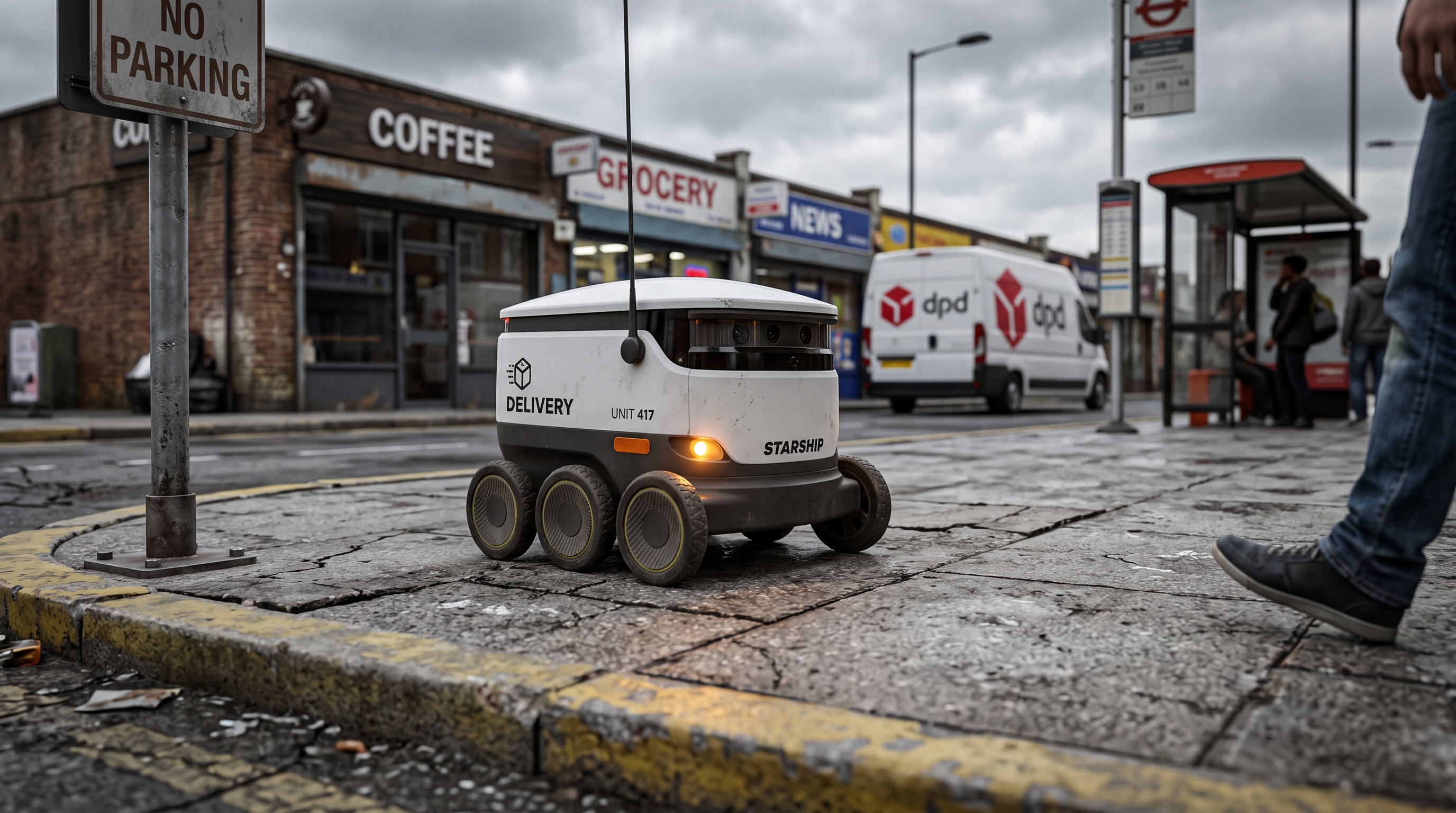
The Robot Is Already at Your Door, and Your City Has No Idea What to Do About It
As of May 2023, 24 U.S. states had already enacted laws for personal delivery devices, turning what began as campus experiments into a nationwide regulatory scramble. That number has only grown since. The six-wheeled cooler humming along your sidewalk at jogging pace is no longer a tech demo or a curiosity worth filming for social media. It is a daily operational reality in dozens of American cities, and the legal frameworks meant to govern it are, to put it charitably, a work in progress.
The terminology alone tells you how unprepared most governments were when these machines showed up. Depending on which document you read, sidewalk delivery robots are called Personal Delivery Devices (PDDs), Sidewalk Autonomous Delivery Robots (SADRs), or Automated Delivery Vehicles and Devices (ADVDs). A white paper from the Minnesota Department of Transportation runs through the competing definitions before settling on its own preferred framing, which is itself a small illustration of the problem: every jurisdiction is essentially naming the animal before deciding what to do with it. When your robot doesn't legally exist as its own category, the results in court get creative fast.
For most of the early deployment period, cities essentially let it ride. Robots rolled out on campuses, then into suburban pilot zones, then onto public sidewalks under a patchwork of state enabling laws that said, roughly, "yes, these can exist." What those laws mostly did not address was who gets to decide where they go, or what happens when one parks itself in front of a wheelchair ramp. A 2024 transportation research report cataloguing PDD legislation across the U.S. found that most state laws confine robots to sidewalks and crosswalks, impose speed limits somewhere between 3.5 and 12 mph, and require robots to yield to pedestrians. What those laws generally do not do is give cities meaningful tools to manage day-to-day operations on the ground. The gap between "technically legal" and "actually managed" is exactly where we are right now.
"When your robot doesn't legally exist as its own regulatory category, the results in court get creative fast."
The state-versus-city tension here is genuinely messy. Virginia became the first U.S. state to allow personal delivery devices, starting in 2017, and then expanded the framework significantly in 2020, raising the allowable robot weight from 50 pounds to 500 pounds and allowing robots on road shoulders where no sidewalk exists. The 2020 legislation also removed delivery robots from the list of motorized vehicles that local governments could ban outright from sidewalks. A Virginia Association of Counties analysis of the bill noted that an early draft would have eliminated local authority to restrict robots entirely, but the final version preserved cities' ability to prohibit PDDs on specific sidewalks or crosswalks by ordinance. That is a meaningful distinction, but it still means a city in Virginia cannot simply pass a blanket "no robots on Main Street" rule if the state framework says otherwise.
Maryland took a softer approach, building a framework that requires operators to give at least 30 days' notice to every county and municipality before deployment. That sounds reasonable until you realize that notice is not the same as permission. The locals get a heads-up; they do not get a vote. Meanwhile, a city that has imposed a moratorium operates in a completely different competitive environment, where robot delivery is flatly unavailable and the regulatory landscape looks nothing like the one two counties over. Same country, same year, radically different rules depending on which side of a municipal boundary you happen to sit on. The robots did not create this inconsistency, but they are making it very difficult to keep ignoring.
What makes 2026 feel like an inflection point is that the patchwork is starting to harden. A 2025 policy analysis from the Institute for Research on Public Policy found that rapid deployment of autonomous delivery robots was consistently outpacing municipal planning, particularly around disability access. The concern was not that the technology was inherently problematic; it was that governance structures were moving faster than the cities actually responsible for the sidewalks. That dynamic describes most mid-sized American cities right now, where a state enabling law exists, a robot fleet is operating, and the city's formal response is somewhere between "we're looking into it" and a hastily drafted amendment to a micromobility ordinance originally written for scooters. The scattered rules of the early deployment years are beginning to calcify into something more permanent, and the cities that haven't gotten ahead of it are about to find out what it costs to catch up.
Who Actually Controls These Things: A Map of the Regulatory Patchwork
There is no single answer to "who regulates sidewalk robots," and that is not an accident. The federal government has, so far, largely stayed out of sidewalk robot regulation specifically. These devices tend to fall below the threshold of federal motor vehicle definitions, which means the usual federal preemption that applies to car safety standards does not automatically kick in. That leaves the field to states, and states have gone in genuinely different directions.
The scale of that variation is worth sitting with for a moment. A 2024 transportation research report cataloguing PDD legislation across the U.S. found that as of May 2023, 24 states had enacted PDD laws, while four states had failed to pass legislation and five more were actively considering bills. The states that did act created frameworks with very different philosophies. Some passed enabling legislation that essentially clears the runway for operators, defining PDDs as a legal category and setting baseline rules. Others have done almost nothing, leaving robots in a gray zone where they might technically be classified as pedestrians or as vehicles depending on which statute a lawyer decides to argue from on a given Tuesday.
Virginia's approach was to enable deployment while explicitly limiting what localities could do to restrict it. Maryland went with a notification model: operators must give prior notice to every county and municipality where they intend to run robots, but the state retains the overarching framework. Neither approach gives cities the granular control they would need to, say, ban robots from a specific block near a school during dismissal hours, or require dedicated staging areas near a busy restaurant district. These are not exotic demands. They are the kind of operational specificity that anyone who has actually walked a crowded city sidewalk at 5 p.m. would immediately recognize as necessary.
"Some states have left robots in a gray zone where they might technically be classified as pedestrians or as vehicles, depending on which statute a lawyer decides to argue from on a given Tuesday."
Washington, D.C. offers a useful contrast in how detailed a framework can get when a jurisdiction actually commits to writing one. D.C.'s Personal Delivery Device program, administered by the District Department of Transportation, requires robots to weigh no more than 90 pounds excluding cargo, stay under 10 mph, operate only on sidewalks and crosswalks, and remain visible from at least 300 feet at all times. The D.C. code provision formally authorizing PDDs restricts them to areas outside the central business district unless operators meet additional conditions. That level of specificity, speed, weight, visibility distance, geographic exclusion zones, is what separates a framework that actually shapes robot behavior from one that just establishes that robots are allowed to exist.
The Minnesota Model and What It Reveals
The Minnesota Department of Transportation's white paper on PDDs makes the case explicitly for local authority: sidewalk conditions vary too much for state-level rules to cover adequately, and PDD regulation should be integrated into local curb-management policy rather than treated as a standalone issue. That is a state transportation agency essentially arguing that it should not be the last word on this, which tells you something about how unworkable purely top-down frameworks have become in practice. Under Minnesota's proposed framework, PDDs would need to carry at least $100,000 in liability insurance, display visible lights and a unique ID, and operate no faster than 12 mph in pedestrian areas. The detail is instructive: when you actually try to write rules that work on real sidewalks, you end up specifying things like headlight visibility distance and braking system requirements, the same unglamorous engineering parameters that govern every other vehicle on the road.
A speed limit that works fine on a wide suburban sidewalk in a Sun Belt city is a genuinely different proposition on a narrow 1920s-era sidewalk in a dense northeastern neighborhood. States writing uniform rules rarely have that granularity in mind, and the result is that cities bear the friction of rules calibrated for somewhere else. A 2025 policy analysis from the Institute for Research on Public Policy found this pattern playing out in the Canadian context as well, where provincial-level deployment initiatives were consistently outpacing municipal planning and disability-access considerations. The governance structure was moving faster than the cities responsible for the actual sidewalks. That dynamic is not unique to Canada. It describes most mid-sized American cities right now, and the MnDOT white paper's implicit acknowledgment of that problem is one of the more honest things a state transportation agency has put in writing on this subject.
What the New Ordinances Actually Say (and What They Leave Out)
San Francisco has more experience with sidewalk robot deployments than almost any other American city, and its response has been to maintain tight restrictions and pilot-only operating zones. San Francisco tightened its regulations on delivery robots after early deployments generated enough pedestrian complaints to make the issue politically unavoidable. That is one end of the spectrum. The other end is a city that watched things get bad enough that elected officials started using the word "chaos" in public meetings, then wrote rules in response to the chaos. Coral Gables, Florida landed firmly in that second category.
By early 2026, Coral Gables city officials were describing the situation on their sidewalks as "food delivery robot chaos," a phrase used in an actual city commission meeting that tells you more about the current state of PDD governance than most whitepapers do. The ordinance that followed set a maximum sidewalk speed of 7 mph, required robots to yield to pedestrians at all times, and prohibited "loitering," meaning robots cannot sit idle in ways that block foot traffic. Those provisions sound modest. What they actually represent is a city using regulation as a substitute for infrastructure planning. Coral Gables is not rebuilding its sidewalks to accommodate robots. It is writing rules that force robots to behave as if the sidewalks were already designed for them, which is a very different thing.
"When your policy response is being driven by the word 'chaos,' you are not ahead of the curve. You are writing rules to stop the bleeding, not to build something that works."
The anti-loitering provision deserves more attention than it usually gets. Curb ramps are federally mandated accessibility features under the ADA, and a robot idling in front of one is not a minor inconvenience for someone using a wheelchair; it is a potential compliance issue for the city that permitted the robot's operation in the first place. Coral Gables' "no loitering" rule looks considerably more pointed when you frame it that way. Boston's 2025 sidewalk delivery robot guidelines took a more proactive approach to this problem, recommending that robots operate no faster than 5 mph around pedestrians, weigh no more than 150 pounds including cargo, and avoid operating near school zones, senior living facilities, and construction areas entirely. Boston also recommended starting with a fleet cap of no more than 12 units and expanding only if operations remained demonstrably safe. That sequencing, small pilot first, expansion contingent on evidence, is the opposite of how most cities have handled this.
The Micromobility Merger Nobody Announced
One of the quieter but more consequential trends in recent ordinances is that several cities stopped treating delivery robots as a standalone issue and started folding them into broader micromobility frameworks. The administrative logic is real: cities already built out permitting infrastructure for scooter fleets starting around 2018, and that machinery, including data-sharing requirements and geofenced operating zones, translates reasonably well to robot fleets. One city agency, one compliance framework, one phone number to call when something goes wrong.
The risk is that robots are not scooters. A scooter sitting on a sidewalk is inert. A robot sitting on a sidewalk is still making navigation decisions, still consuming curb space, and potentially still creating a hazard for someone using a wheelchair or a white cane. The CNIB, which advocates for people with vision loss, has raised specific concerns about how micro-mobility utility devices, including delivery robots, interact with pedestrians who rely on predictable, unobstructed sidewalk environments. Jamming robots into the same regulatory box as scooters is administratively efficient, but it may paper over real differences in how these devices interact with the public right-of-way. A scooter ordinance was not written with a 90-pound autonomous device in mind, and the gaps show.
The Cities That Just Said No
Not every city landed on "regulate and manage." Toronto's city council voted to ban sidewalk robots outright, citing concerns about pedestrian safety and sidewalk capacity. The ban passed despite operators having run pilots in the city, which suggests that even demonstrated real-world experience was not enough to overcome the accessibility and congestion concerns raised by disability advocates and residents. That is not a fringe outcome driven by technophobia. It reflects a genuine calculation about whose needs the sidewalk is primarily supposed to serve.
The bans are worth taking seriously as a policy choice, even if you think they are ultimately wrong. A city that bans robots entirely has, at minimum, a clear rule that operators and merchants can plan around. A city that permits robots under vague or unenforced conditions creates a different kind of problem: when operators push boundaries and incidents accumulate, the eventual regulatory response tends to be harsher than it would have been with clearer rules from the start. A 2025 policy analysis from the Institute for Research on Public Policy flagged exactly this pattern, finding that rapid deployment without municipal planning led to retroactive restrictions that were more disruptive to operators than upfront rules would have been. Coral Gables is a version of that story. It allowed robots, watched the problems develop, and then wrote the rules it probably should have written two years earlier. Whether its current ordinance actually works is something the city has no systematic way to measure, because the rules contain no data-reporting requirement that would tell officials whether any of this is functioning as intended.
Your Sidewalk Is Now a Contested Design Problem
Most American sidewalks were designed for exactly one use case: a person walking. No loading zones for robots, no staging areas, no accommodation for a 90-pound autonomous device that needs to navigate a curb cut while a stroller, a mobility scooter, and three pedestrians are already competing for the same four feet of concrete. A METRANS Transportation Center study on sidewalk autonomous delivery robot interactions found that introducing robots onto urban pathways presents a genuine challenge precisely because existing sidewalk designs rarely account for robots as regular users of those spaces. That is a polite way of saying that a lot of sidewalks are too narrow or too cluttered with street furniture and utility infrastructure to accommodate a robot reliably. The robot doesn't know that until it gets there, and often neither does the city planner who approved the deployment zone from a map.
The physical mismatch between robot capabilities and actual sidewalk conditions is not a minor implementation detail. It is the central design problem that legal frameworks keep stepping around. A state law setting a 12 mph speed limit for PDDs says nothing about whether the sidewalk where the robot is operating is 6 feet wide or 3 feet wide, whether there is a bus shelter cutting into the usable path, or whether the curb ramp at the corner has a lip that causes the robot to stop and recalibrate in the middle of pedestrian flow. Agent-based modelling research on sidewalk delivery robots has begun to quantify these interaction dynamics, finding that robot behavior in dense pedestrian environments produces conflict patterns that vary significantly depending on sidewalk geometry. In other words, the same robot, running the same software, behaves very differently on different blocks. The law treats it as a uniform device. The sidewalk does not.
"The same robot, running the same software, behaves very differently on different blocks. The law treats it as a uniform device. The sidewalk does not."
Where Robots Actually Struggle
A study from Northern Arizona University on sidewalk robot routing identified something that urban designers will find immediately recognizable: the most problematic spots for robots are the ones that are already problematic for everyone else. The NAU research emphasized the importance of minimizing robot travel through high-activity nodes such as bus stops and crosswalk approaches. These are exactly the locations where sidewalks narrow, foot traffic spikes, and people using mobility aids are most likely to be navigating a curb cut or waiting for a signal. Routing a robot through those spaces during peak hours is not primarily a navigation challenge for the robot; it is a conflict-generation problem for everyone else in the space.
The METRANS study adds another layer. Robots create new interaction patterns at crosswalks and mid-block crossings, often requiring pedestrians to navigate around a device that has stopped or is maneuvering near a curb ramp. That might sound minor until you consider that curb ramps are federally mandated accessibility features, and a robot idling in front of one creates a potential ADA compliance issue for the city that permitted the robot's operation. The CNIB has specifically flagged how devices like sidewalk robots create navigation hazards for people with vision loss, who rely on predictable, unobstructed pedestrian environments in ways that sighted pedestrians can work around more easily. The accessibility concern here is not hypothetical, and it is not being adequately addressed by ordinances that focus on speed limits and yield requirements without specifying anything about where robots can stage or wait between deliveries.
The Curb Is the New Battleground
If sidewalk geometry is one design problem, the curb is an entirely separate one. The Minnesota Department of Transportation's white paper explicitly links PDD regulation to local curb-management policy, calling for coordination between robot operators and city agencies on loading areas and device staging. The question of where a robot waits between deliveries turns out to matter quite a bit. If it parks on the sidewalk, it becomes an obstruction. If it uses a curb lane, it competes with freight loading zones and rideshare pickups. If it needs a dedicated off-street hub, someone has to build and pay for that, and current ordinances are almost entirely silent on who that someone is.
There is a potential upside buried inside this complexity, though it comes with conditions attached. Research modeling robot substitution for short-distance delivery vehicle trips found scenarios where robots replacing vans in dense areas could reduce traffic congestion and greenhouse-gas emissions. Fewer double-parked delivery vans means more usable curb space and fewer blocked bike lanes. The catch is that you trade a single van making ten stops for ten robots each making one stop, distributed across ten different sidewalk segments simultaneously. The net effect on pedestrian flow depends almost entirely on whether the city has designated sensible staging areas or simply let operators figure it out. Most cities are currently letting operators figure it out, which is how you end up with a cluster of 90-pound robots queued outside a popular restaurant on a Friday night, occupying the exact stretch of sidewalk that everyone else also needs to use.
The Permit Fine Print Operators Hope You Won't Read
Washington, D.C. has one of the more detailed permitting frameworks for sidewalk robots in the country, and the specifics are worth reading closely because they illustrate what a real permit actually demands. D.C.'s Personal Delivery Device program requires operators to register each device, maintain procedures for mechanical malfunctions and swift removal, and ensure robots are visible from at least 300 feet at all times. The D.C. code provision formally authorizing PDDs restricts them to areas outside the central business district unless additional conditions are met. That is a permitting system with actual teeth: specific visibility requirements, geographic restrictions, and a removal protocol that puts the burden on the operator when something goes wrong. Most cities have nothing like it.
In a surprising number of jurisdictions right now, the answer to "does your city know the robot was operating there" is "not really." Permitting frameworks for delivery robots range from genuinely detailed licensing systems to something closer to an honor system. Maryland's approach sits toward the more structured end: operators must give at least 30 days' prior notice to every county and municipality where they plan to deploy, within a framework set by state statute. Maryland's connected and automated vehicle program sets out these notification requirements as a baseline condition for operation. The limitation is that notification is not approval. A city gets the heads-up; it does not get to negotiate routes or require safety reviews before operations begin. For a small city with limited transportation staff, "30 days' notice" may mean a letter arrives, gets forwarded to the wrong department, and the robots show up anyway.
"In a surprising number of jurisdictions, the answer to 'does your city know the robot was operating there' is: not really."
What a Real Permit Should Actually Include
Cities that have built more substantive permitting systems tend to require general liability insurance and compliance with local operating standards. Minnesota's DOT white paper recommends that operators carry at least $100,000 in liability insurance as a baseline condition, which is a reasonable floor given that these devices are operating continuously in spaces shared with pedestrians, cyclists, and people using mobility aids. The insurance question deserves more attention than it usually gets. When a robot causes an incident, the liability picture is genuinely unclear in many jurisdictions. Is the operator liable? The merchant who contracted for the delivery? The software company whose navigation system made the wrong call? A permitting system that requires operators to carry liability insurance and name the city as an additional insured is not bureaucratic overreach. It is the city doing what any reasonable property manager would do before letting someone run a commercial operation on its infrastructure.
The integrated micromobility ordinances that folded PDDs into scooter-style frameworks took the permitting question further, authorizing a single agency to set fleet caps and define operating areas across device types. That gives the city a meaningful lever: if an operator exceeds its permitted fleet size or operates outside designated zones, there is a clear enforcement mechanism attached to a license the operator actually needs to keep. Boston's 2025 sidewalk delivery robot guidelines built this kind of staged accountability into their pilot framework, recommending a starting cap of 12 units with expansion contingent on demonstrated safety. The cap is not just a safety measure; it is a negotiating tool. An operator that wants to scale has an incentive to comply with reporting requirements and route restrictions, because non-compliance puts the expansion at risk.
The Data Gap Nobody Is Talking About Loudly Enough
Most cities have almost no systematic data on what their permitted robot fleets are actually doing. How many trips per day? Which routes? How often do robots stop in ways that block curb ramps? Nobody with regulatory authority knows, because most current ordinances do not require operators to report it. The 2025 IRPP policy analysis argued that cities should require robot operators to share route data and incident reports so that planners can evaluate impacts on vulnerable road users and adjust street designs over time. That is a reasonable ask, and it is also one that large operators have historically resisted, citing proprietary concerns about fleet routing data.
The tension is familiar from the scooter conflicts of 2018 and 2019, when cities fought with operators over Mobility Data Specification compliance. Robots are heading into the same fight, and cities that do not build data-sharing requirements into their initial permits will find themselves trying to retrofit that requirement onto operators who are already established and have considerably less incentive to comply. The window for getting permit conditions right is the moment before an operator is entrenched, not after. A city that issues a permit without data-reporting obligations has essentially agreed to run a commercial delivery operation on its public infrastructure with no feedback mechanism whatsoever, which is an odd arrangement when you think about it for more than thirty seconds.
What Bans and Tight Rules Mean for Small Merchants
Last-mile delivery is expensive, and the platforms charging for it have known that for years. Third-party delivery fees can run 15 to 30 percent of order value, and for a restaurant or small retailer operating on thin margins, that math is genuinely punishing. Sidewalk robots, at least in theory, offer a different cost structure for short-distance deliveries, one where the per-trip cost drops as the fleet scales and where the merchant is not subsidizing a human driver's time and a car's fuel for a half-mile trip. Whether any specific merchant can actually access that potential depends almost entirely on what their city's ordinance says, which means the regulatory question and the economic question are the same question.
The market is not small. A 2023 MarketsandMarkets projection estimated the delivery robot market growing from around $0.80 billion in 2025 to $3.24 billion by 2030, a compound annual growth rate of 32.4%. That is a consultancy forecast, not a guarantee, but the directional signal is consistent with what operators are actually doing: DPD in the UK expanded robot deliveries to 10 towns and cities, and Starship Technologies has continued scaling its campus and suburban deployments. The technology is not waiting for regulatory consensus to arrive. It is already moving, which means the merchants in cities with clear permitting frameworks are in a fundamentally different position from those in cities that have banned robots or left the rules ambiguous.
"The regulatory question and the economic question are the same question. A restaurant in a city that bans sidewalk robots is competing for delivery customers against platforms that use robots elsewhere, and it does not get the cost benefit."
Consider what a ban actually means in competitive terms. A restaurant in a city that prohibits sidewalk robots is competing for delivery customers against platforms that use robots in adjacent or comparable markets. It does not get the cost benefit. Its customers do not get a faster or cheaper delivery option. Toronto's city council voted to ban sidewalk robots despite operators having run active pilots there, which means businesses in Toronto are now operating under a different set of delivery economics than businesses in, say, Markham, Ontario, where SkipTheDishes has been running robot delivery trials. Those two cities are 30 kilometers apart. The competitive gap between them is not theoretical.
The Access Problem Nobody Advertises
Even in cities where robots are permitted, access is not evenly distributed. The 2025 IRPP policy analysis warned that without clear rules and genuine consultation, sidewalk robots may end up deployed mainly in affluent areas, while safety problems or infrastructure deficiencies in lower-income neighborhoods trigger the kind of restrictive local responses that effectively exclude those communities from the service. That pattern, if it holds, means the merchants most likely to benefit from lower delivery costs are the ones in neighborhoods that already have better sidewalk infrastructure and more political capacity to shape local ordinances in their favor. The small corner store in a neighborhood with cracked, narrow sidewalks may never see a robot delivery service, not because the technology cannot work there, but because no operator will bother navigating the physical and regulatory friction.
There is also a payload problem that gets almost no attention in the policy conversation. Local regulations can restrict robot dimensions and payload weight to protect pedestrians, and those restrictions directly constrain which goods small merchants can actually deliver by robot. A speed cap and a weight limit calibrated around food delivery does not work well for a hardware store trying to deliver a bag of concrete or a boutique sending out a large framed piece. The ordinances being written right now are being calibrated around food delivery use cases, because that is where the visible robot deployments are concentrated. Merchants in other retail categories may find that by the time they want to use robot delivery, the rules have already been written around someone else's business model, with no obvious pathway to get the parameters adjusted.
Where the Real Opportunity Sits
Research modeling robot substitution for short-distance delivery trips finds the strongest congestion and emissions benefits in dense urban areas where van-based delivery is already inefficient due to parking constraints and traffic. That same density profile is where a small merchant is most likely to have customers within a half-mile radius who would genuinely use same-hour delivery if it were affordable. The use case is real; it is just narrower than the marketing implies, and it requires a specific combination of permissive local rules, functional sidewalk infrastructure, and an operator whose permit actually allows them to service independent merchants rather than only large platform accounts.
That last condition matters more than it might seem. Early permitting frameworks often focused on operator-level licensing without specifying which merchants could access the service. A robot fleet permitted to operate in your city might be contractually or operationally limited to serving a handful of large restaurant chains, with no clear pathway for an independent retailer to participate. The merchants who will benefit first from robot delivery are probably not the ones waiting for a platform to show up in their city. They are the ones who have already read their city's current PDD ordinance, confirmed that independent merchants are eligible under the terms of the permit, and checked whether the sidewalk infrastructure between their storefront and their customer base is actually navigable. That is unglamorous due diligence, but it is the difference between being ready when a viable service arrives and discovering two years later that the operating zone stops three blocks short of your neighborhood.
Cities Getting It Right, Cities Getting It Wrong
Grading cities on robot regulation is a little like grading students on a test nobody studied for, because the syllabus only arrived last year. Most cities are not getting it spectacularly wrong so much as they are improvising in real time. But some patterns are emerging that separate the cities building durable frameworks from the ones that will be rewriting their ordinances again in eighteen months, and the differences are instructive.
The clearest marker of a city getting ahead of the problem is whether its robot rules connect to something larger. Cities that fold PDD regulation into existing curb-management policy are building on infrastructure they already have: permit offices with enforcement mechanisms and data-sharing agreements already in place. A 6 mph limit enforced through a real permitting system with genuine consequences is more effective than a 7 mph limit that exists only on paper. Minnesota's DOT white paper specifically recommends integrating PDD rules into local curb-management policy rather than treating robots as a standalone regulatory problem, and the cities that have done this organically are already ahead of the ones still drafting robot-specific ordinances from scratch. The mechanism matters more than the specific number in the speed limit.
"A 6 mph limit enforced through a real permitting system with genuine consequences is more effective than a 7 mph limit that exists only on paper. The mechanism matters more than the number."
Boston Versus Coral Gables: Two Models, One Lesson
Boston's 2025 sidewalk delivery robot guidelines represent what proactive regulation actually looks like. The city set a 5 mph speed recommendation around pedestrians, capped early pilots at 12 units, restricted operating hours to between 5 a.m. and midnight, and required operators to avoid school zones and senior living facilities. Critically, Boston built expansion contingency into the framework from the start: fleet size increases only if operations remain demonstrably safe. That sequencing, small pilot first with evidence-based scaling, gives the city real leverage over operators and a feedback mechanism that most ordinances lack entirely. It is also the kind of framework that disability advocates can engage with meaningfully, because the constraints are specific enough to evaluate rather than vague enough to argue about indefinitely.
Coral Gables took the opposite path and paid for it. The city allowed robots, watched problems accumulate until officials were using the word "chaos" in public meetings, and then wrote reactive rules optimized for stopping complaints rather than building a system that works over time. The honest assessment of Coral Gables is not that its ordinance is bad; a 7 mph speed cap and a yield requirement are reasonable baseline rules. The problem is that the ordinance contains no data-reporting requirement, which means the city has no systematic way to know whether its rules are working. It will find out the same way it found out the previous approach was not working: through accumulated complaints and visible problems. That is a slow and unpleasant way to run infrastructure policy, and it is the predictable result of writing rules after the fact rather than before.
The International Contrast Worth Paying Attention To
Toronto and Vancouver, two Canadian cities with similar urban profiles, have taken almost opposite approaches. Toronto banned sidewalk robots outright, citing pedestrian safety and the concerns of disability advocates. Vancouver, by contrast, approved a six-month delivery robot pilot program, choosing a time-limited, evidence-gathering approach rather than a permanent prohibition. Neither city is obviously wrong. Toronto's ban gives everyone a clear rule to plan around. Vancouver's pilot gives the city actual data to work with before committing to a permanent framework. What Vancouver is doing that Toronto is not is treating the question as empirically open rather than already settled, which seems like a reasonable posture when the technology is still relatively new and the evidence base is still thin.
The cities that are genuinely getting it right share one characteristic that has nothing to do with their specific ordinance text: they are treating sidewalk robot policy as a planning problem rather than purely a legal one. The NAU research on robot routing and the METRANS study on sidewalk robot interactions both point toward the same conclusion: effective robot deployment requires matching device capabilities to physical infrastructure at a granular level. That is fundamentally a planning and design task. The cities writing ordinances without simultaneously asking "which of our sidewalks can actually support this" are building rules on top of a foundation they have not examined. Some will be fine. Others will find out the hard way that a permitted robot fleet and a functional robot delivery network are not remotely the same thing, and that by the time the problems become visible, the operators are already entrenched and considerably harder to rein in.
So Where Does This Leave Your Business?
Here is the part of the robot delivery conversation that almost nobody in a business context is having yet. The regulatory picture described in every section above has a direct commercial translation, and it is more granular than "robots are coming, get ready." Two businesses with identical products and identical delivery needs can face completely different competitive landscapes based purely on which side of a municipal boundary they operate from. That is unusual even by the standards of local business regulation, and it makes the standard advice, "watch this space," genuinely insufficient. The space is already here. What differs is whether your specific city's rules give you anything to work with.
The first genuinely useful thing any small merchant can do right now is find out exactly what their city's current ordinance says, not what the state enabling law says in general terms, and not what a robot company's sales rep describes as "coming soon to your area." Those two sources will give you the most optimistic possible picture. The ordinance will give you the actual one. If your city has no PDD ordinance at all, that is also information: it means operators are either not present or are running in a regulatory gray zone, and either scenario has implications for how much you can rely on robot delivery as a stable part of your logistics in the near term.
"The standard advice is 'watch this space.' The space is already here. What differs is whether your specific city's rules give you anything to work with."
The Sidewalk Between You and Your Customer Actually Matters Now
This is the due diligence question that almost no merchant is asking operators directly: not "do you serve my area" but "what is your actual route coverage within my area." The NAU research on robot routing flagged high-activity nodes, including bus stops and busy crosswalk approaches, as locations operators actively try to minimize exposure to. Busy commercial streets with complicated pedestrian flows are exactly the kind of places robot fleets will route around if they can. A delivery service that nominally covers your neighborhood but avoids your block because the sidewalk conditions are poor is not a delivery service you can build expectations around. The scooter industry trained cities to ask hard questions about parking corrals and operating zones; robot delivery requires the same scrutiny applied to routing, and most merchants have not started asking yet.
The METRANS study on sidewalk robot interactions found that robots create new conflict patterns at crosswalks and mid-block crossings that vary significantly depending on sidewalk geometry. If your storefront is on a narrow, high-foot-traffic street near a school entrance or a transit stop, you may be technically inside a permitted operating zone but practically outside the area where operators will route their fleets. Knowing that before you build a delivery strategy around robot availability is considerably more useful than finding out after a few months of unreliable service that the operating map and the actual coverage area are not the same thing.
What to Watch in the Next 12 Months
The regulatory picture will shift before mid-2027, and the shifts that matter most for small merchants are not the headline ordinances but the secondary provisions buried inside them. Watch for whether your city's next PDD rule update includes data-reporting requirements for operators. Cities that adopt data-sharing frameworks will start building the kind of evidence base that allows for smarter operating-zone decisions over time. Cities that skip data requirements will keep making robot policy based on complaint volume, which is a poor proxy for actual impact and produces the reactive, blunt-instrument regulation that Coral Gables exemplifies.
Also watch your state legislature for movement on preemption. If you are in a state where local authority over robot deployment is currently limited, a legislative session that expands municipal control could change your city's options significantly. The 2025 IRPP analysis found that rapid deployment driven by higher-level government initiatives consistently outpaced municipal planning, and that pattern has not resolved itself in the time since that report was published. Conversely, if your city has a ban or tight restrictions, a state-level preemption move could override local rules that your community spent real time developing. The most concrete action a small merchant can take right now is to pull up their city's current PDD ordinance, check whether it includes data-reporting obligations for operators, and ask any robot delivery service they are evaluating whether independent merchants are actually eligible under the terms of the city's permit. Those two questions will tell you more about whether robot delivery is a realistic near-term option for your business than any product announcement or pilot press release.
Sources
Northern Arizona University: Sidewalk Delivery Robot Routing Research, supports findings on high-activity pedestrian nodes and robot navigation challenges.
York University: Agent-Based Modelling and Simulation of Sidewalk Delivery Robots, supports analysis of robot-pedestrian conflict patterns and sidewalk geometry effects.
Institute for Research on Public Policy: Cities Need to Get Ahead of Autonomous Delivery Robots, supports findings on deployment outpacing municipal planning, equity concerns, and the case for operator data-sharing requirements.
METRANS Transportation Center: Evaluation of Sidewalk Autonomous Delivery Robot Interactions, supports analysis of robot interactions at crosswalks, curb ramps, and urban pedestrian infrastructure.
The Robot Report: Toronto City Council Votes to Ban Sidewalk Robots, supports coverage of Toronto's outright ban and the disability-access concerns driving it.
Cities Today: Toronto City Council Votes to Ban Pavement Robots, supports the finding that Toronto's ban passed despite operators having run active pilots in the city.
CBC News: Food Delivery Robots in Markham Test Appetite for High-Tech Takeout, supports the contrast between Toronto's ban and active robot delivery trials in nearby Markham, Ontario.
Smart Cities Dive: San Francisco Tightens Regulations on Delivery Robots, supports coverage of San Francisco's restrictive approach and pilot-only operating zones.
BBC News: San Francisco to Restrict Goods Delivery Robots, supports background on San Francisco's early regulatory response to sidewalk robot deployments.
District Department of Transportation: Personal Delivery Devices Program, supports detail on Washington D.C.'s permitting requirements including weight, speed, and visibility standards.
D.C. Law Library: § 50-1555 Personal Delivery Device Operation, supports the legislative basis for D.C.'s PDD authorization and geographic restrictions.
D.C. Law Library: D.C. Law 22-137, Personal Delivery Device Act of 2018, supports the legislative framework underpinning Washington D.C.'s PDD program.
Minnesota Department of Transportation: Personal Delivery Devices White Paper, supports analysis of PDD regulatory frameworks, insurance requirements, and the case for integrating robot rules into local curb-management policy.
.svg)