


The $143M Wake-Up Call Nobody in the West Is Talking About
In January 2026, a Chinese humanoid robotics company called X Square Robot quietly closed an A++ funding round worth roughly 1 billion yuan, or about US$143 million. That alone would be noteworthy. What makes it genuinely interesting is who wrote the checks: ByteDance and HongShan Capital (the firm formerly known as Sequoia China) led the round, with Meituan, Alibaba, and Shenzhen Capital Group, a state-backed investor that had just stood up a dedicated AI and robotics technology fund, all joining at the same table. When the ideological enemies of Silicon Valley's venture model and the Chinese Communist Party's industrial policy arm are co-investing in the same robot startup, something structural is happening.
X Square's round did not happen in a vacuum. According to data tracked by HumanoidsDaily, more than 10 billion yuan (roughly US$1.4 billion) poured into domestic Chinese humanoid startups in just the first 60 days of 2026. Chinese market research firm IT Juzi, cited in reporting by ChosunBiz, found that cumulative fundraising by humanoid and embodied-AI companies in China had already surpassed 46 billion yuan in 2026 by mid-year, exceeding the total raised across all of 2025. That is not a funding trend. That is a funding avalanche, and it is largely aimed at a specific target: small and mid-sized manufacturers who need automation but cannot afford a custom robotics integration project that costs more than their annual equipment budget.
"When ByteDance and Alibaba are sitting at the same cap table as the Chinese state, you are not watching a venture bet. You are watching industrial policy with a term sheet attached."
The Western press has mostly covered this as a geopolitical curiosity or a supply-chain risk story. What it actually is, for anyone running a manufacturing or logistics operation, is a preview of what the competitive floor for automation is about to look like. China's approach is not just about building cheaper robots. State subsidy on the developer side, combined with policy-driven incentives on the buyer side and platform-scale distribution through companies like Meituan, creates a deployment flywheel that the U.S. market simply does not have a structural equivalent to right now.
X Square's total raise had climbed to around 3 billion yuan across nine financing rounds by early 2026, and subsequent reporting from ChosunBiz put its valuation above 20 billion yuan by mid-year, after four follow-on rounds with continued participation from Xiaomi, IDG Capital, China Mobile, and several of the original backers. For context, that valuation puts X Square in the same neighborhood as several publicly traded U.S. cobot companies, except X Square has not gone public yet and is still in aggressive growth mode. The company is not a household name in the West. It probably should be.
There is a tendency in American business coverage to treat Chinese robotics funding as a distant abstraction, something that matters to trade negotiators and defense analysts but not to the owner of a mid-sized contract manufacturer in Ohio or a warehouse operator in the Inland Empire. That framing is getting harder to defend. The robots being funded right now in Shenzhen are explicitly designed for the same use cases that U.S. cobot vendors have been pitching to SMEs for the past decade: picking and packing, machine tending, and intralogistics across production floors built for humans. The difference is that China is funding the supply side and the demand side simultaneously, while the U.S. model still largely asks small businesses to figure it out on their own.
Meet X Square Robot: The Startup Redefining What a Cobot Can Be
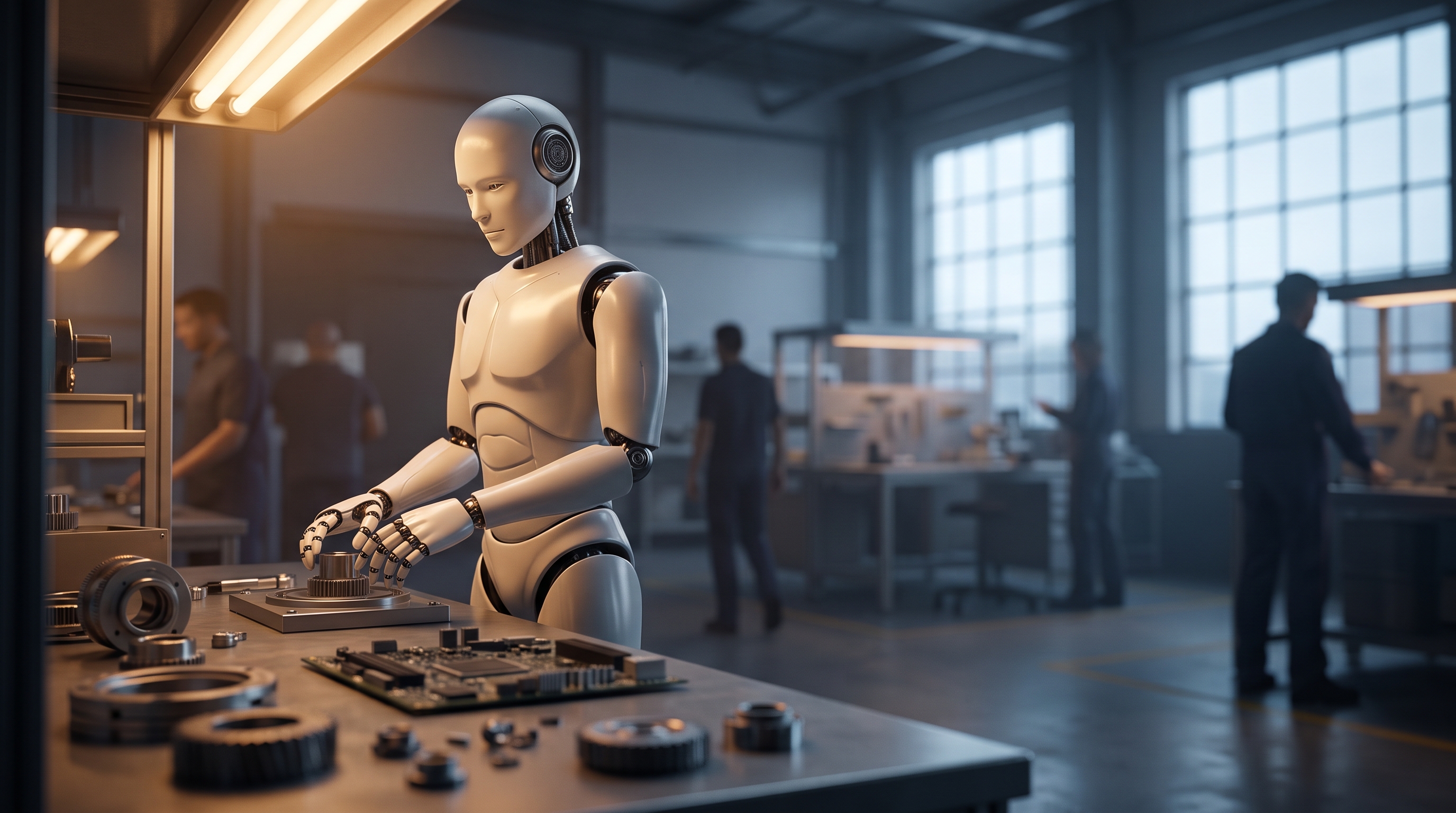
The classic image of a collaborative robot is a single arm bolted to a workbench, doing one thing very well, whether that is tightening a screw or placing a component on a conveyor. X Square Robot is building something with considerably more ambition. The company sits at the intersection of what Chinese industry is now calling "embodied AI," a term that describes AI models that do not just process text or images but physically act in the world through a robot body. X Square's humanoid platforms are designed to take general-purpose AI reasoning and put it into a form factor that can walk into a warehouse, read the environment, and immediately start doing useful work without a six-month custom integration project.
Describing X Square's exact geographic home is, entertainingly, a minor controversy. Caixin describes it as Beijing-based, while Shenzhen media consistently claim it as part of the Shenzhen innovation ecosystem. The practical answer is probably "both," which is increasingly common for Chinese tech companies that maintain R&D operations in one city and capital relationships in another. What is not in dispute is that X Square has raised around 3 billion yuan in total across nine financing rounds, a fundraising cadence that suggests its investors are not treating this as a speculative moonshot but as a company on a relatively near-term path to commercial deployment at scale.
"X Square is not building a better robot arm. It is building a robot that shows up to work the way a person does, reads the room, and figures out what needs doing, without waiting to be reprogrammed."
The "embodied AI" framing is worth taking seriously rather than dismissing as marketing language. Traditional cobots, from companies like Universal Robots or Fanuc's collaborative lines, are programmed for specific tasks and excel at repetitive precision work. They are genuinely useful, but they require significant setup time, and changing their task often means reprogramming from scratch. X Square's pitch, and the pitch of the broader humanoid wave it belongs to, is that a robot running a sufficiently capable AI model can be redirected to a new task the way you would redirect a new employee: with instruction rather than code. Whether that promise holds up at production scale is still being tested, but the investor base backing it is not composed of naive optimists. ByteDance and Alibaba did not get to their current scale by funding science fair projects.
The SME angle is where X Square's story connects most directly to the cobotics market that Western companies have been cultivating for years. Its humanoid robots are explicitly designed for the kind of multi-step tasks that small manufacturers deal with every day: picking and packing, machine tending, basic assembly work, intralogistics, all in environments built for humans rather than fixed automation. The traditional cobot value proposition was always "automation that fits in a human workspace without a cage." X Square is taking that idea further by adding "and can be redirected without an integrator every time your product line changes." For an SME running short production runs on tight margins, that flexibility argument is genuinely compelling.
What separates X Square from a typical startup story is the participation of the National SME Development Fund in the broader humanoid funding wave that X Square belongs to. That fund's involvement signals that Chinese industrial policy is explicitly connecting humanoid and embodied-AI robots to the needs of small and mid-sized manufacturers, not just to showcase factories or large state enterprises. This is a meaningful distinction. In the U.S., SME automation policy tends to show up as tax incentives or occasional grant programs. In China, the policy architecture runs deeper: it shapes which companies get funded, which buyers get subsidized, and which technology categories get designated as national priorities. X Square did not just raise money. It got designated as part of an industrial agenda.
None of this means X Square has solved robotics. Humanoid robots are still expensive, still prone to the kinds of edge-case failures that make production managers nervous, and still require significant infrastructure to deploy reliably. The gap between a compelling demo and a robot that works a full shift without supervision remains real. But the pace of capital flowing into closing that gap, specifically in China, specifically aimed at SME use cases, is fast enough that dismissing it as hype is probably the more dangerous mistake at this point.
How China Funds Its Robot Revolution (And Why It's Not a Fair Fight)
Start with a number that does not get enough attention: according to data from Chinese market research firm IT Juzi, cited in ChosunBiz's mid-2026 reporting, cumulative fundraising by humanoid and embodied-AI companies in China had already exceeded 46 billion yuan by the halfway point of 2026, surpassing the total raised across all of 2025. In the first 60 days of 2026 alone, HumanoidsDaily tracked more than 10 billion yuan flowing into domestic humanoid startups. China's robotics funding machine is not accelerating gradually. It is compressing years of capital deployment into months.
The reason this is structurally different from a normal venture boom comes down to who is doing the funding and why. In the U.S., robotics investment is predominantly private: venture capital firms making bets on technology they believe will generate returns, with the occasional corporate strategic round thrown in. The calculus is commercial. In China, the capital stack for a company like X Square layers ByteDance and Alibaba as strategic investors on top of HongShan Capital as a top-tier VC, with Shenzhen Capital Group underneath as a state-backed vehicle that explicitly exists to advance industrial policy goals. These are not competing motivations sitting awkwardly at the same table. They are designed to reinforce each other. The state sets the direction, the platforms provide distribution and data, and the VC provides the growth discipline. It is a coordinated system dressed up in the language of market competition.
"China is not just subsidizing robot builders. It is subsidizing robot buyers too, and that double-sided intervention is what makes the math work for SMEs in a way it simply does not in the U.S."
The buyer-side subsidy piece is the part that rarely makes it into Western coverage. Chinese industrial policy does not stop at funding the companies building robots. Shenzhen's 2026 policy moves, referenced in regional technology briefings, included explicit incentives for SME adopters of automation technology, reducing the upfront cost barrier that has historically been the single biggest obstacle to cobot deployment in small manufacturing operations. When a government simultaneously lowers the cost of building a robot and lowers the cost of buying one, the adoption math changes completely. A U.S. small manufacturer deciding whether to invest in automation is running a private ROI calculation with full sticker price. A Chinese SME in a policy-priority sector is running a very different calculation.
It is also worth being clear about what "state-backed" actually means in practice, because the term gets flattened into a vague geopolitical boogeyman in a lot of Western commentary. Shenzhen Capital Group is not a bureaucratic fund writing slow checks to politically connected companies. It is a sophisticated investment vehicle that has backed some of China's most commercially successful technology companies, and its involvement in AI and robotics reflects a deliberate decision to treat embodied AI as a national infrastructure priority, the way earlier generations of Chinese industrial policy treated semiconductor fabs or high-speed rail. The strategic logic is straightforward: if humanoid robots become the default automation layer for manufacturing, whoever controls the leading platforms controls a significant portion of global industrial output. That is the bet being made, and it is being made with a level of policy coherence that has no real counterpart in Washington right now.
The U.S. is not entirely absent from the policy conversation. The CHIPS and Science Act of 2022 directed significant federal funding toward semiconductor manufacturing, and there are robotics-adjacent provisions in various advanced manufacturing initiatives. But the scale and specificity are different. Federal robotics policy in the U.S. tends to focus on defense applications and research grants rather than on accelerating commercial deployment for civilian SMEs. The National Robotics Initiative, run through the National Science Foundation, funds academic research. It does not fund the buyer incentives or the platform infrastructure that would make a small contract manufacturer in Tennessee as likely to adopt a collaborative robot as one in Shenzhen. That gap is a policy choice, not an inevitability, but it is a choice that is getting more expensive to ignore.
None of this is an argument that the Chinese model is without costs or contradictions. State-directed capital has a long history of funding impressive-looking capacity that struggles to generate genuine commercial returns, and the humanoid robotics space is early enough that a lot of the current valuations are running on narrative as much as revenue. But the sheer volume of coordinated capital, combined with a policy architecture that addresses both supply and demand, means that even a 50% failure rate among Chinese humanoid startups leaves a formidable set of survivors with massive deployment experience and cost structures that private-only funded competitors will find very hard to match.
The Shenzhen Playbook: State Capital Meets Big Tech Meets SME Policy
No other Chinese city combines Shenzhen's three defining characteristics in quite the same way: a manufacturing base dense enough to source almost any component within an hour's drive, a tech ecosystem that has produced globally competitive companies across hardware and software, and a track record as Beijing's preferred testbed for industrial policy experiments before they go national. That combination is not accidental, and it is precisely why the embodied AI and humanoid robotics wave is centered there rather than in Beijing or Shanghai.
The investor structure of X Square's A++ round is essentially a diagram of the Shenzhen playbook in action. Shenzhen Capital Group joined the round via a newly established AI and robotics technology fund, which is significant because it signals that the city is not just passively watching the humanoid boom but actively structuring new vehicles to participate in it. State capital at the city level, channeled through a purpose-built fund rather than an existing general-purpose vehicle, is a sign of deliberate policy prioritization rather than opportunistic investment. Shenzhen is not buying a lottery ticket in robotics. It is building the lottery infrastructure.
"Shenzhen's approach to robotics funding is not venture capital with Chinese characteristics. It is industrial policy with a cap table."
The Big Tech dimension of this playbook deserves its own examination. ByteDance and Meituan are not obvious robotics investors at first glance. ByteDance is a content and advertising platform. Meituan is a food delivery and local services giant. But both have strong strategic reasons to care about embodied AI. Meituan's entire business model depends on last-mile logistics and service delivery, and a humanoid robot that can navigate a restaurant kitchen or a delivery hub is directly relevant to its cost structure. ByteDance's interest is less immediately obvious but likely relates to the intersection of AI model development and physical deployment, since embodied AI robots are, in a meaningful sense, a distribution channel for large AI models. When your AI can act in the physical world, the addressable market for that AI expands enormously. These are not charitable investments. They are strategic positions in an infrastructure layer that the investors expect to matter a great deal.
The SME policy dimension completes the picture. Reporting on the broader humanoid funding wave noted participation from China's National SME Development Fund in the ecosystem surrounding companies like X Square. That fund's mandate is explicitly to support small and mid-sized enterprises, and its presence in the humanoid robotics capital stack signals that Chinese policymakers are not thinking about these robots as tools for large state enterprises or showcase factories. The intended end user is a small manufacturer with 50 to 200 employees who cannot afford a traditional fixed-automation line but is facing rising labor costs and increasing quality demands from customers. The policy architecture is designed to make humanoid robots accessible to exactly that operator, through subsidized robot costs and financing support that reduce deployment risk on both sides of the transaction.
Compare that to how SME automation policy typically works in the United States. The primary federal mechanism is the Section 179 tax deduction, which allows businesses to deduct the full purchase price of qualifying equipment in the year of purchase rather than depreciating it over time. That is genuinely useful, but it is a passive instrument: it reduces the cost of automation for businesses that have already decided to buy and have the capital to deploy. It does nothing to address the integrator shortage or the upfront cash requirement that stops most small manufacturers before they even get to the ROI spreadsheet. The Shenzhen model addresses those friction points simultaneously. The U.S. model addresses one of them, partially, after the fact.
What makes the Shenzhen playbook particularly hard to replicate quickly is that it depends on institutional relationships that took decades to build. The trust between Shenzhen Capital Group and the city's tech ecosystem, the supply chain relationships that let a humanoid startup source components at competitive prices, the manufacturing know-how embedded in the local workforce, and the regulatory flexibility that lets new robot form factors get tested in real commercial environments without years of certification delay: none of that can be conjured by a policy announcement. It is infrastructure of a different kind, social and institutional rather than physical, and it is what turns a funding round into a deployment wave rather than just a press release.
What U.S. Collaborative Robot Platforms Are Actually Doing
Universal Robots, the Danish company that essentially invented the modern cobot category and is now owned by Teradyne, shipped its 100,000th collaborative robot in 2023. That is a genuine milestone, and the company deserves credit for building a product that made industrial automation accessible to manufacturers who previously could not justify the cost or complexity of traditional robotics. The UR platform's ecosystem of plug-and-play accessories and certified integrators is legitimately impressive. But 100,000 units over roughly 15 years of commercial operation is also a number that puts the scale of the current Chinese funding wave into sharp relief. China's humanoid startups raised more capital in the first two months of 2026 than Universal Robots has likely spent on R&D across its entire history as an independent company.
The U.S. cobot market is software- and platform-centric in a way that reflects both genuine strategic thinking and the constraints of operating without significant public subsidy. Companies like Universal Robots and newer entrants like Veo Robotics have focused heavily on the software layer: making robots easier to program, easier to integrate with existing manufacturing execution systems, and easier to redeploy as production needs change. The UR+ ecosystem, for instance, allows third-party developers to build certified accessories and software applications that extend the platform's capabilities without requiring custom engineering for every deployment. That is a genuinely smart approach to scaling adoption without scaling a direct sales force proportionally.
"The U.S. cobot industry built a very good platform and then handed the deployment problem to a fragmented integrator ecosystem that was never going to scale fast enough to reach every small manufacturer who needed it."
The platform strategy has real strengths. It means U.S. cobot companies can grow their addressable market without proportionally growing their headcount, and it creates network effects as more integrators and accessory developers build on the platform. But it also has a structural weakness that becomes more visible in comparison to the Chinese model: it pushes the last-mile deployment problem onto a fragmented ecosystem of third-party integrators, many of whom are small regional firms with limited capacity. A small manufacturer in rural Ohio who wants to deploy a cobot still needs to find a qualified integrator, negotiate a project scope, and then wait out a deployment that can stretch across months before the robot is doing anything productive. The technology is ready. The deployment infrastructure is the bottleneck, and no amount of software elegance fixes that.
Boston Dynamics, now owned by Hyundai, represents the U.S. end of the humanoid and mobile robotics spectrum, though its commercial trajectory has been more complicated than its viral videos suggest. Spot, the quadruped robot, found genuine commercial traction in inspection and monitoring applications, but at price points that put it well out of reach for most SMEs. Atlas, the humanoid platform, remains primarily a research and development vehicle rather than a commercial product. The gap between what Boston Dynamics can demonstrate in a controlled environment and what it can deploy reliably at SME scale is still significant, and the company has not shown the same urgency to close that gap that X Square's funding cadence implies.
Figure AI raised $675 million in early 2024 from a group that included Microsoft, Nvidia, and OpenAI, according to Reuters reporting at the time. Apptronik has backing from Google. These are serious companies with serious investors, and the U.S. humanoid space is not standing still. But the funding scale remains smaller than the Chinese wave, the policy support is thinner, and neither company has articulated an SME deployment strategy with the same specificity that China's industrial policy framework provides. They are building impressive robots. The question of how a 75-person manufacturer in the Midwest actually gets one deployed and running productively is largely still an open one.
There is one area where U.S. platforms hold a genuine structural advantage: software ecosystem depth and AI model integration. The concentration of large language model and foundation model development in the U.S., at companies like OpenAI and Anthropic, means that U.S. robotics companies have relatively direct access to the most capable AI systems for training robot behavior. Embodied AI, the concept that makes humanoid robots more flexible than traditional cobots, depends heavily on the quality of the underlying AI models. Whether that software advantage translates into a durable hardware deployment lead is the central question of the next several years, and right now the answer is genuinely unclear.
The SME Automation Gap: Who Gets Left Behind and Why
According to the U.S. Census Bureau's Statistics of U.S. Businesses, firms with fewer than 500 employees account for roughly 99.9% of all U.S. businesses and nearly half of private-sector employment. Manufacturing SMEs specifically, the contract manufacturers and job shops that form the backbone of American industrial capacity, are the segment most likely to face labor shortages, most likely to compete with lower-cost overseas production, and least likely to have the capital or technical staff to deploy automation without significant outside help. The cobot industry was supposed to fix this. It has made genuine progress. But the gap between "automation is theoretically accessible to SMEs" and "SMEs are actually automating at scale" remains stubbornly wide.
The reasons for that gap are not mysterious. A typical cobot deployment for a small manufacturer involves hardware costs, integration costs, safety assessment and staff training, and ongoing maintenance, and the integration costs alone frequently exceed the hardware cost. Industry observers have long noted that a cobot arm priced at $35,000 can easily require $50,000 to $100,000 in integration work before it is doing anything useful on a production floor. For a manufacturer with $2 million in annual revenue and thin margins, that total investment is a significant bet. If the product line changes in 18 months, or if the integration does not deliver the expected throughput, the financial exposure is real. This is not a technology problem. It is a deployment economics problem, and software platforms alone have not solved it.
"The cobot industry spent a decade making robots easier to program and almost no time making them easier to actually deploy in a real small business, and that ordering of priorities shows in the adoption numbers."
The labor shortage context makes this more urgent than it might have seemed five years ago. Bureau of Labor Statistics Job Openings and Labor Turnover Survey data has consistently shown manufacturing among the sectors with persistently elevated job openings relative to hires, a pattern that accelerated after 2020 and has not fully normalized. Small manufacturers are not choosing between automation and a full workforce. Many of them are choosing between automation and leaving production capacity on the table because they cannot find or retain the workers to fill it. That changes the ROI calculation for cobot deployment, but it does not change the upfront capital requirement or the integrator availability problem. Urgency and affordability are not the same thing.
The geographic dimension of this problem is underappreciated. Certified cobot integrators are not evenly distributed across the United States. They cluster around existing manufacturing hubs and major metro areas, which means a small manufacturer in a rural or semi-rural location faces longer lead times, higher travel costs for on-site integration work, and fewer options if the primary integrator relationship does not work out. A manufacturer in the greater Detroit area or the Research Triangle has a meaningfully different automation ecosystem available to it than one in rural Mississippi or western Kansas. Policy discussions about SME automation tend to treat the U.S. as a uniform market, but the deployment infrastructure is anything but uniform.
China's approach to this problem is structurally different in ways that go beyond subsidy amounts. The combination of state-directed capital on the supply side and explicit SME incentives on the demand side is designed to compress the adoption cycle, but the less-discussed element is the role of platform companies like Meituan in distribution. A logistics or service robot backed by Meituan does not need to find its way to an SME customer through a fragmented integrator channel. Meituan already has commercial relationships with hundreds of thousands of small restaurants and retailers. It can deploy robots through existing account relationships the way a software company deploys a new app feature. That distribution model has no real equivalent in the U.S. cobot market, where even the largest players rely on indirect channels that add cost and time to every deployment.
The risk for U.S. manufacturing SMEs is not that Chinese humanoid robots will suddenly appear on American factory floors next year. Tariffs and export controls make that scenario unlikely in the near term. The real risk is more subtle: that Chinese SMEs automate faster and at lower cost, improving their productivity and quality enough to compete more effectively in global markets where American small manufacturers are already under pressure. Automation is not just an operational tool. At sufficient scale and speed, it is a competitiveness variable, and the policy infrastructure currently in place in the U.S. is not moving at the same pace as the capital flowing into Shenzhen.
Humanoid vs. Arm-on-a-Stand: Why the Form Factor War Matters for Small Business
Here is a question that sounds philosophical but is actually quite practical: should a robot look like a human? For most of industrial automation's history, the answer was an emphatic no. Factory robots were designed around the task, not around the human body. A welding robot looks like a welding robot. A pick-and-place machine looks like a pick-and-place machine. The cobot era softened this somewhat, producing arm-on-a-stand designs that could share a workspace with humans, but the underlying logic was still task-centric. You bought a cobot to do a specific job in a specific location. The humanoid wave is making a different argument entirely: that the most efficient way to automate a human workspace is with a robot that fits into it the way a human does.
The practical case for humanoid form factors in SME environments is stronger than it might initially seem. Most small manufacturing and logistics facilities were designed for human workers. The workbenches are at human height. The aisles are sized for human bodies. The tools are designed for human hands. Deploying a traditional cobot arm in that environment often requires physical modifications to the workspace and custom end-of-arm tooling, plus safety zoning that can eat into the floor space a small operation cannot afford to lose. A humanoid robot that can walk to a workstation, pick up an existing tool, and perform a task in the space as it already exists sidesteps a significant portion of that integration cost. The workspace modification problem does not disappear entirely, but it shrinks considerably.
"The reason humanoid robots are getting so much investment right now is not aesthetics. It is that the entire built environment, every factory and warehouse on earth, was already designed for a body shaped like theirs."
The counterargument from the cobot side is legitimate and should not be dismissed. A fixed cobot arm doing a single task well is more reliable and precise, and easier to certify for quality-controlled production, than a humanoid robot attempting the same task with a general-purpose body. Universal Robots' UR10e, for instance, has repeatability specifications of plus or minus 0.05 millimeters, which is the kind of precision that matters enormously in electronics assembly or medical device manufacturing. No current humanoid robot matches that level of precision for fine manipulation tasks. For SMEs where product quality tolerances are tight and consistent, the arm-on-a-stand is still the more defensible choice for specific high-precision applications. The humanoid pitch is not that it beats a dedicated cobot at its best task. It is that it can do twelve different tasks adequately, which for many small businesses is actually more valuable than doing one task perfectly.
The task-flexibility argument is where the economics get genuinely interesting for small business owners. A manufacturer running short production runs on multiple product lines does not just need automation. It needs automation that can be redirected quickly as the product mix changes. A traditional cobot deployment optimized for Product A requires reprogramming, often by a specialist, to handle Product B. If that changeover happens frequently, the labor cost of managing the cobot starts to erode the savings from deploying it. A humanoid robot running a capable AI model, in theory, can be redirected with significantly less engineering intervention. The word "in theory" is doing real work in that sentence, because the current generation of humanoid robots is not yet delivering that flexibility reliably at production scale. But the trajectory of improvement, combined with the capital being deployed to accelerate it, suggests the gap between theory and practice is closing faster than the traditional cobot industry's roadmap anticipated.
There is also a workforce psychology dimension that rarely appears in the ROI spreadsheets. Workers tend to have strong reactions to automation, and the nature of those reactions often depends on the form the automation takes. A fixed robot arm that takes over one specific task is perceived differently than a humanoid robot that moves through the same spaces as human workers, uses the same tools, and performs a broader range of activities. Some workers find humanoid robots less threatening because they read as colleagues rather than replacements for specific roles. Others find them more unsettling for exactly the same reason. Small business owners deploying automation have to manage these dynamics in a workforce where every individual relationship matters, and the form factor of the robot is not a neutral variable in that conversation.
What this means practically is that the choice between humanoid and arm-on-a-stand is not going to resolve into a single winner. Each task and facility layout will favor a different answer, and workforce dynamics add another layer on top of that. The more consequential question for U.S. small businesses is not which form factor is theoretically superior but which one is going to be more accessible and better supported by the surrounding ecosystem over the next five years. Right now, the capital flowing into humanoid development in China is building toward a future where that form factor becomes the lower-cost, more flexible option for general SME automation. Whether U.S. platforms can match that trajectory without equivalent policy support is the real competition being run, and the scoreboard is updated every time another billion yuan closes in Shenzhen.
So What Does This Mean If You Run a Small Business in 2026?
The honest answer is: probably not as much as the hype suggests in the next 12 months, and considerably more than most small business owners are currently planning for over the next five years. The gap between a well-funded Chinese humanoid startup closing a billion-yuan round and a robot actually working a reliable shift in your facility is still measured in years, not quarters. But the decisions you make about automation infrastructure and workforce planning in the near term will shape how well-positioned you are when that gap closes. Waiting for the technology to be "ready" before paying attention to it is how you end up making rushed decisions under competitive pressure instead of deliberate ones with time to learn.
The most immediately actionable insight from the China funding wave is not about which robot to buy. It is about what the competitive environment for your customers and competitors is likely to look like in 2028 to 2030. If your business competes in a market where Chinese manufacturers are also competing, and if those manufacturers are deploying flexible automation at subsidized cost while you are still running manual processes or waiting for an integrator to have availability, the productivity differential compounds quietly until it becomes visible in your order book. This is not a reason to panic. It is a reason to treat automation planning as a capital planning priority rather than something you revisit every few years when a vendor calls.
"The small business owners who will navigate this well are not the ones who buy the most impressive robot. They are the ones who figure out their actual deployment bottleneck first and solve that, whether the answer is a cobot arm or a better-organized warehouse with a solid software layer on top."
For manufacturers and logistics operators who are ready to move on automation now, the practical landscape in mid-2026 looks like this: traditional cobot arms from established vendors like Universal Robots remain the most mature and precisely capable option for defined, repeatable tasks, with a well-documented integrator ecosystem to support deployment. The software platforms layered on top of these systems have also improved significantly, making reprogramming less painful than it was even three years ago. If you have a specific, stable task that needs automating and you have access to a competent integrator, a cobot arm is still a very reasonable choice.
The more interesting question for small business owners is what to do about the integrator bottleneck, which remains the single most consistent obstacle to SME cobot deployment regardless of which hardware platform you choose. Some operators have addressed this by investing in internal automation expertise, hiring or developing staff who can handle basic programming and maintenance without external support for every change. That investment has a real cost in time and salary, but it also removes a dependency that has derailed a lot of otherwise sensible automation projects. The Manufacturing USA network, a federally supported consortium of manufacturing innovation institutes, offers training resources and technical assistance that can help build that internal capacity without starting from zero.
On the humanoid and embodied AI side, the honest advice for most small business owners right now is to watch closely and pilot carefully rather than commit heavily. The technology is advancing fast enough that a deployment decision made today could look premature in 18 months, but the operational learning from even a small pilot, one robot, one task, one shift, is genuinely valuable and hard to get any other way. Figure AI and Apptronik are beginning to run commercial pilots with manufacturing partners, and getting into an early pilot program, even if the first deployment is imperfect, puts you ahead of competitors who are still reading about it.
The broader policy picture is worth monitoring even if you are not a lobbyist or a trade association member. The contrast between China's coordinated, dual-sided subsidy approach and the U.S.'s more fragmented policy toolkit is a gap that American industry groups are increasingly aware of. The National Association of Manufacturers has been vocal about the need for more aggressive domestic manufacturing policy, and there are legislative proposals in various stages of development that would expand incentives for SME automation adoption. Whether any of them pass in a form that meaningfully changes the deployment economics for small manufacturers is uncertain, but the conversation is happening at a level of seriousness it was not at two years ago. Staying informed about those policy developments costs nothing and could matter quite a lot to your capital planning.
Here is the concrete version of what X Square's January 2026 round actually signals for a U.S. small business owner: China is simultaneously lowering the cost of building flexible robots and subsidizing the cost of buying them, while the U.S. still relies on private ROI calculations and a thin integrator channel to drive adoption. If you compete with Chinese manufacturers in any product category, start by identifying the single highest-labor-cost repetitive task in your operation, get a real quote from two integrators for automating it, and use that number to anchor your 2027 capital budget conversation. That is not a grand strategic move. It is the kind of specific, bounded action that separates businesses that are ready for what comes next from those that will be scrambling to catch up when the cost curves shift further than expected.
Sources
Eye on Shenzhen: X Square Robot raises $143M, covers the January 2026 A++ funding round and X Square's position within the Shenzhen robotics ecosystem.
ChosunBiz: China fuels humanoid robot boom as valuations soar and bubble fears rise, provides mid-2026 data on cumulative Chinese humanoid fundraising exceeding 46 billion yuan, valuations above 20 billion yuan, and investor participation from Xiaomi, IDG Capital, and China Mobile.
Caixin Global: Humanoid robot startup X Square nets big-name backers in $143 million raise, details the investor mix including ByteDance, HongShan Capital, Meituan, Alibaba, and Shenzhen Capital Group, and X Square's total funding history across nine rounds.
CMRA: Two Shenzhen firms raise hundreds of millions of yuan in one-day funding blitz, illustrates the pace and scale of Shenzhen-based robotics fundraising activity in the 2025-2026 period.
Shenzhen Tech Watch: The top 4 Chinese robotics startups that raised the most, provides context on the leading Chinese robotics startups by fundraising volume and their place within the broader embodied AI wave.
NYU Shanghai RITS: Shenzhen Longgang backs OpenClaw with millions in subsidies for one-person AI companies, illustrates Shenzhen's district-level subsidy mechanisms for AI and robotics companies, supporting the analysis of buyer- and developer-side policy incentives.
HumanoidsDaily: The $1.4 billion sprint; inside China's post-Gala humanoid funding frenzy, documents the more than 10 billion yuan that flowed into Chinese humanoid startups in the first 60 days of 2026.
.svg)