


Introduction
Picture this: it's 3 AM, and somewhere in a quiet strip mall, a shadowy figure is helping themselves to the day's earnings at your local boutique. The security guard is catching some Z's in his car, dreaming about his upcoming vacation. The CCTV cameras are diligently recording footage that someone might watch eventually. Meanwhile, your hard-earned money is making its grand escape through the back door.
If you're a small business owner or property manager, you're probably nodding along. This has been the standard playbook for decades: a couple of cameras, a motion sensor that trips on stray cats, and a guard who's technically present but spiritually elsewhere. It's not a knock on anyone; it's just the reality of what traditional retail security has always looked like.
What's changing now is that security has become as much a software problem as a staffing problem. AI systems are already being deployed at shopping centers to filter camera feeds, flag after-hours activity, and help small teams of guards focus on verified incidents rather than chasing down every false alarm. We're not talking about science fiction. A 600-pound robot named Marshall is currently patrolling a parking lot in Kansas City. Mall of America launched facial recognition security measures in 2024. Vendors are building AI layers specifically designed to cut the noise that burns out monitoring teams.
The case for AI security isn't really "robots replacing guards." It's more interesting than that. The real argument is that AI can act as a force multiplier for understaffed teams, covering more ground, filtering out the junk alerts, and escalating only what actually matters. For small business owners and strip mall operators who can't afford round-the-clock staffing, that's a meaningful shift.
This post walks through how that shift is happening, what the technology actually does, where the real-world results have been promising, and where the legitimate concerns live. Because there are legitimate concerns, and anyone selling you a frictionless AI security future without mentioning them is probably also selling you oceanfront property in Nebraska.
The Security Problem Isn't Just About Crime Rates
Before getting into the technology, it helps to understand why traditional security setups struggle even when everyone involved is doing their job reasonably well.
The core issue is scale versus attention. A typical strip mall or shopping center might have dozens of cameras covering parking lots, entrances, loading docks, and common areas. A single guard or remote monitoring operator can only meaningfully watch a handful of feeds at once. The rest is essentially unmonitored in real time, recorded but not reviewed unless something already went wrong. That's not negligence; it's just human cognitive capacity hitting a wall.
Motion-triggered alerts were supposed to help, but they created a different problem. Security monitoring vendors describe this as "alert fatigue": systems generate so many false positives from wind, shadows, animals, and normal foot traffic that operators start tuning them out. When everything is urgent, nothing is. Guards end up dispatched on ghost runs, chasing alerts that turn out to be a shopping cart rolling across an empty lot at 2 AM. Over time, the system trains the people using it to take it less seriously.
The staffing side has its own pressures. Security guards are expensive relative to what most small commercial properties can budget, and coverage gaps are common, especially during overnight hours and weekends. Mall security increasingly relies on a layered stack of cameras, access controls, and guard patrols, but for smaller properties, that full stack is often out of reach financially. You end up with partial coverage and the hope that your location isn't interesting enough to attract serious attention.
That hope doesn't always hold. And when it doesn't, the footage you pull afterward is often exactly as useful as you'd expect from a passive recording system: blurry figures, bad angles, and a timestamp that confirms something happened without helping you figure out who did it or how to prevent it next time.
What AI Security Actually Does (And Doesn't Do)
The marketing language around AI security can get breathless quickly, so it's worth being specific about what these systems actually do in practice.
Filtering the Feed
The most widely deployed application right now isn't a robot or a facial recognition system. It's AI video analytics running on top of existing camera infrastructure, analyzing footage in real time to separate events worth human attention from background noise. Instead of a motion alert firing every time a leaf blows past a sensor, the system applies behavioral logic: Is this person moving in a pattern consistent with loitering? Has this vehicle been parked in the same spot for six hours? Is there activity near a restricted entrance at 4 AM?
Only the events that match policy-defined criteria get escalated to a human operator. The rest gets filtered out. Vendors in this space, including Ranger (an AI monitoring layer built for retail properties), claim false alarm reductions of 60 to 95 percent in pilot deployments. Those are vendor figures, not independently audited results, so treat them as directionally interesting rather than gospel. The underlying logic is sound, though: if you can cut the noise, the signal gets clearer, and your guard team spends time on things that actually need them.
Behavior and Pattern Detection
AI systems can monitor crowd density, flag unusual movement patterns, and identify congestion or safety hazards before they escalate. For large mixed-use retail properties, this kind of continuous analysis across dozens of camera feeds simultaneously is simply not something a human team can replicate. The AI doesn't replace the judgment call; it surfaces the situation so a human can make one.
This is also where the technology moves beyond pure crime prevention into broader safety and operations. Crowd analytics can help a property manager identify bottlenecks at entrances, monitor whether a parking lot is filling faster than usual during an event, or catch a medical emergency in a common area faster than a fixed patrol schedule would allow.
Facial Recognition and Watchlists
This is where the technology gets more complicated, both technically and ethically. Some mall security vendors describe facial recognition systems that can identify individuals flagged as trespassers or security risks and alert staff in real time when those individuals enter the property.
Mall of America went this route. The property launched new AI facial recognition security measures in 2024, which prompted immediate civil liberties concerns from privacy advocates and legal observers. The questions raised weren't abstract: Who ends up on the watchlist, and how? How long is biometric data retained? What's the process for someone who's wrongly flagged? How do you appeal a trespass designation enforced by an automated system?
These aren't reasons to dismiss the technology, but they are reasons to take it seriously as a policy question, not just a technical one. More on that in a moment.
Security Robots
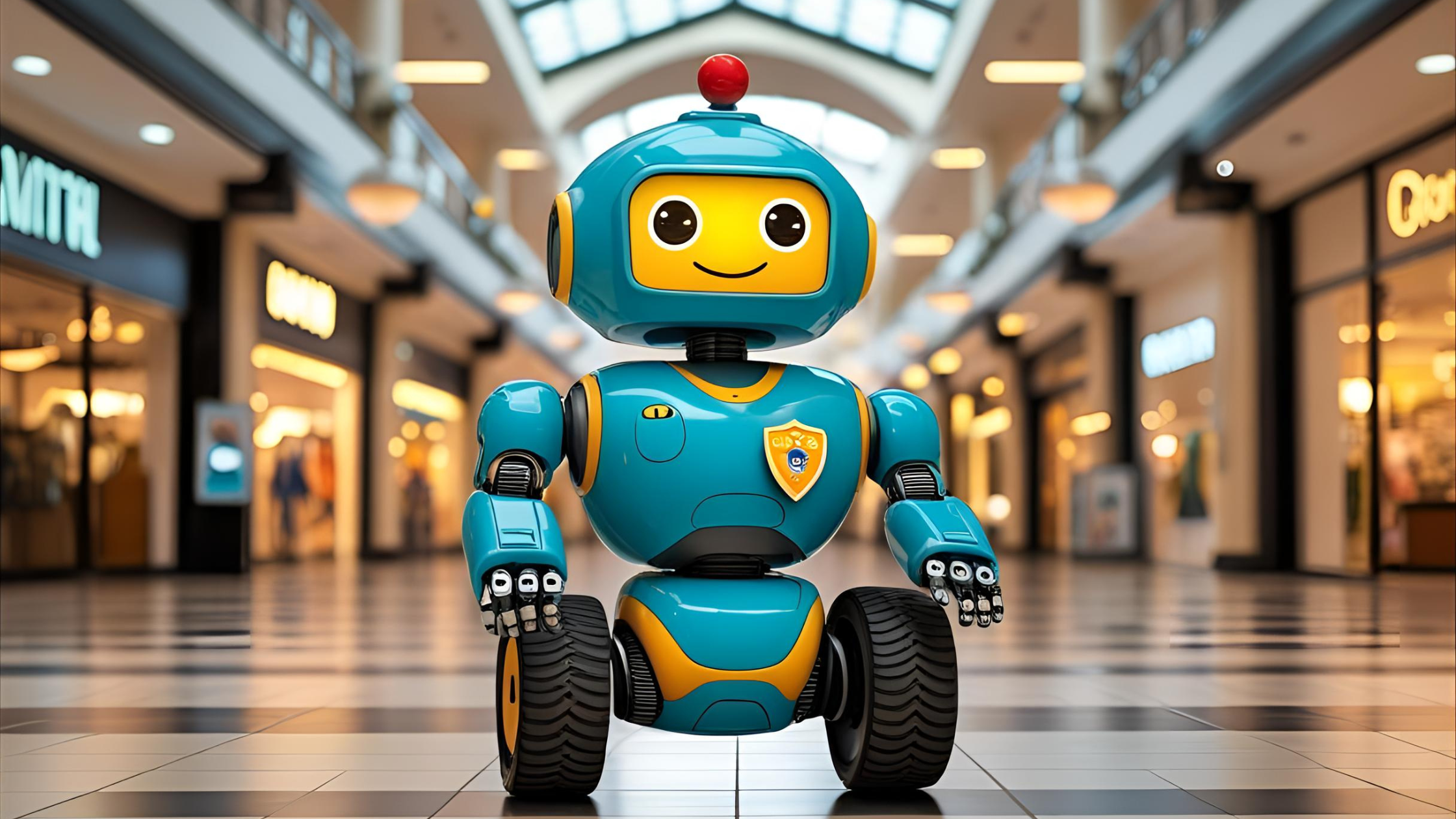
Yes, they're real, and yes, they're genuinely being deployed. A Kansas City shopping center deployed a 600-pound AI security robot named Marshall to patrol its parking lot. The property manager reported that crime dropped by approximately 50 percent over the four months following deployment. Marshall operates roughly 21 hours a day, pausing only for brief charging intervals, which is a coverage consistency that no human patrol can match at comparable cost.
One property, one reported outcome, over four months. That's not a peer-reviewed study. It's a promising data point, and it illustrates what autonomous patrol can do in a specific context: consistent presence in a high-risk outdoor area, at hours when human staffing is thinnest. For parking lots, which tend to be the most vulnerable and least monitored parts of any retail property, that consistent presence has real deterrent value.
The Mall of America Case: Scale, Results, and the Fine Print
The most detailed public example of AI security at a large retail property involves Mall of America and its deployment of Corsight AI's facial recognition platform. The scale alone is worth pausing on: Mall of America covers 5.6 million square feet, making it one of the largest retail properties in North America. Monitoring that space in real time, across hundreds of camera feeds, is a genuinely hard problem.
According to Corsight AI's own case study, the deployment increased trespasser interventions by over 200 percent while reducing false alerts. Those are striking numbers. They're also vendor-reported numbers from a case study the vendor published, which is a meaningful distinction. Independent audits of AI security performance in retail environments are rare, and the gap between vendor claims and independently verified outcomes is a known issue across the industry.
What makes the Mall of America case useful as an illustration isn't the specific percentages. It's the problem it was trying to solve. A 5.6-million-square-foot property with heavy foot traffic, multiple entrances, a large parking structure, and a history of trespassing incidents needs a way to help security staff act on the right information at the right time. Facial recognition, whatever its limitations, addresses a specific operational gap: identifying a known trespasser who has returned to the property, faster than a human team scanning crowds could.
Whether the tradeoffs are worth it is a separate question, and one that critics of the Mall of America deployment argued loudly in 2024. Their concerns weren't hypothetical. Facial recognition systems have documented accuracy disparities across demographic groups, and deploying them in a high-traffic consumer space without clear public disclosure raises accountability questions that don't disappear just because the security outcomes look good on paper.
What This Looks Like for a Strip Mall or Small Business District
Mall of America and its 5.6 million square feet are not your situation. So what does AI security actually look like for a smaller commercial property?
The most accessible entry point is AI video analytics layered onto existing CCTV infrastructure. If you already have cameras, you may not need to replace them. The AI runs as a software layer, analyzing the feeds your existing system produces and filtering what gets escalated to your guard team or monitoring service. The operational benefit is immediate: fewer ghost runs, less alert fatigue, and a guard team that's responding to verified events rather than spending their shift chasing shadows.
For after-hours coverage in parking lots, the Kansas City robot model is worth watching. A 600-pound autonomous patrol unit isn't going to fit every property's budget or context, but the underlying logic applies at smaller scales too. Consistent, visible presence in outdoor areas during off-hours is a deterrent, and AI-assisted patrol (whether robotic or camera-based) can provide that consistency more reliably than a staffing schedule that has gaps.
Access control is another practical application. Biometric scanners, smart card systems, and mobile credentials for restricted areas are increasingly standard in commercial security, and AI can integrate with these systems to flag anomalies, like a credential being used at an unusual time or from an unexpected location, without requiring a human to monitor every access log in real time.
The honest answer on cost is that it varies significantly depending on what you're deploying, at what scale, and whether you're building on existing infrastructure or starting fresh. Anyone quoting you a specific number without knowing your property should be viewed with some skepticism. What's fair to say is that the operational savings from reduced guard hours and fewer false-alarm dispatches can meaningfully offset the cost of AI monitoring tools over time, and that the price of entry for analytics-based systems has come down considerably as the category has matured.
If you're trying to figure out what makes sense for your specific situation, the process automation and digital transformation team at Handybots works through exactly these kinds of technology-to-operations questions. You can reach them at handybots.ai/contact or by calling 415.231.1534.
The Benefits Case, Honestly Stated
Strip away the vendor superlatives and the benefits of AI security tools for retail properties come down to a few concrete things.
Alert quality over alert volume. The single biggest operational improvement AI brings to existing security setups is filtering. When AI triage converts raw camera feeds into verified events before a human operator sees them, the operator's time is spent on situations that actually need attention. That's not a minor efficiency gain; it's a fundamental change in how limited security staff spend their shift.
Coverage without proportional headcount. A small guard team can realistically monitor a much larger perimeter when AI is doing the first-pass filtering across camera feeds. AI security tools are designed to augment existing CCTV and video management systems, not replace them, which means the investment builds on infrastructure you may already have.
Consistency in high-risk windows. Parking lots at 2 AM, loading docks on weekends, perimeter fencing during off-hours: these are the coverage gaps where incidents cluster, and they're also the times when human staffing is thinnest. An AI patrol unit operating 21 hours a day doesn't solve every problem, but it closes a real gap.
Faster response prioritization. When an AI system has already classified an event as a verified trespass rather than a motion artifact, the response can start sooner and with better information. That matters in situations where the difference between intervention and aftermath is measured in minutes.
None of these benefits require the technology to be perfect. They just require it to be better than the baseline it's replacing, which in many small commercial properties is a pretty low bar.
The Concerns Are Real, Not Just Theoretical
Any honest treatment of AI security has to spend real time here, because the concerns aren't edge cases. They're central to how this technology gets deployed in public-facing spaces.
Privacy and Biometric Data
Facial recognition in a shopping center is surveillance of people who haven't consented to it and in many cases don't know it's happening. The Mall of America deployment drew sharp criticism from civil liberties groups precisely because it involved collecting biometric data on millions of visitors without clear public disclosure of retention policies, watchlist criteria, or appeal processes. Those aren't bureaucratic complaints; they're questions about accountability when an automated system gets something wrong.
False Positives and Demographic Bias
AI identification systems have well-documented accuracy gaps across demographic groups, particularly for people of color. In a security context, a false positive isn't just an inconvenience; it can mean a person being confronted, detained, or removed from a property based on a system error. Critics of mall facial recognition deployments have raised exactly this concern, and it's one the industry hasn't fully resolved.
Vendor Claims Versus Verified Outcomes
A significant portion of the performance data circulating in AI security is vendor-generated. The "60 to 95 percent false alarm reduction" figures come from promotional pilot messaging. The "200 percent increase in trespasser interventions" comes from a case study the vendor published about its own product. The "50 percent crime reduction" in Kansas City comes from a single property manager's reported experience over four months. None of this is fabricated, but none of it is independently audited either. Treat it as directionally useful, not as a guaranteed outcome for your property.
Overreliance and the Human Judgment Problem
There's a subtler risk that gets less attention: when guards are trained to act on AI recommendations, errors in the system's detection logic or policy tuning can scale quickly. If the AI is misconfigured to flag a particular behavior pattern as suspicious, every person who exhibits that pattern gets flagged, and every guard who trusts the system acts on it. These tools are designed to influence dispatch and enforcement workflows, which means mistakes don't stay contained to a single incident. Human oversight isn't just a nice-to-have; it's a structural requirement for responsible deployment.
The Regulatory Context
AI deployment in public-facing environments is increasingly part of a broader policy conversation. The federal government's 2023 executive order on safe, secure, and trustworthy AI established governance principles that apply to AI systems affecting people in real-world settings, including transparency, accountability, and protection against discriminatory outcomes. State and local regulations on facial recognition specifically are evolving, and what's permissible today in one jurisdiction may not be in another in two years. If you're deploying facial recognition, knowing your local legal landscape isn't optional.
Where This Is All Heading
The near-term future of retail security isn't "no guards." It's hybrid: AI handling the filtering, pattern detection, and after-hours coverage, with human guards focused on verified incidents and situations that require judgment, de-escalation, or physical presence. Computer vision in physical spaces is part of a broader 2020s shift where cameras are no longer just for recording but for real-time analysis and decision support, and that shift is happening whether any individual property manager opts in or not.
For small business owners and strip mall operators, the practical question isn't whether AI security is theoretically good. It's whether a specific tool, at a specific cost, solves a specific problem better than what you're currently doing. In many cases, the answer is yes, particularly for alert filtering on existing camera infrastructure and for after-hours parking lot coverage. In other cases, particularly around facial recognition, the answer requires a more careful look at the tradeoffs.
The businesses that will get the most out of these tools are the ones that treat AI as a layer on top of human judgment rather than a replacement for it. That means training your team to use the system correctly, auditing the alerts it generates, staying current on what the system is actually flagging, and maintaining clear policies around what happens when the AI is wrong. Which it will be, occasionally. Every system is.
If you're curious how AI fits into a broader security or operations strategy for your property, the post on how small businesses are using AI tools to compete more effectively is worth a read. And if you want to think through what a practical implementation looks like for your specific situation, the digital transformation team at Handybots is a reasonable place to start that conversation.
Frequently Asked Questions
Do I need to replace my existing cameras to use AI security analytics?
Usually not. Most AI video analytics platforms are designed to work with existing camera infrastructure, running as a software layer on top of your current CCTV or video management system. The specific compatibility depends on your camera hardware and the vendor you're evaluating, so it's worth confirming before you commit, but the general pitch from vendors in this space is that you're adding intelligence to existing equipment rather than ripping it out.
Are security robots actually practical for a small strip mall?
Depends on the property. The Kansas City case involved a shopping center with a specific parking lot problem and the budget to try something unconventional. For a smaller property, a full autonomous patrol robot may be overkill, but the underlying need it addresses, consistent after-hours outdoor coverage, is real regardless of property size. AI-assisted camera monitoring can fill some of that gap at lower cost than a physical robot.
What's the difference between AI security and just having more cameras?
More cameras without AI just means more footage that nobody has time to watch. The value AI adds is in real-time analysis: detecting behavioral patterns, filtering out false alarms, and escalating only the events that match your defined criteria. The cameras are the sensors; the AI is the layer that makes them useful in real time rather than just for post-incident review.
Is facial recognition legal for a commercial property to use?
It depends on where you are. Several U.S. states and cities have enacted restrictions on facial recognition use, and the regulatory landscape is still evolving. The Mall of America deployment in 2024 generated significant public and legal scrutiny. Before deploying any facial recognition system, you'll want a clear picture of your local and state regulations, and you'll want policies in place around data retention, watchlist criteria, and what happens when the system makes an error. This is genuinely an area where talking to a lawyer before you talk to a vendor is the right sequence.
Will AI security lower my insurance premiums?
Possibly, but don't bank on it without checking with your insurer first. Some carriers do recognize documented security improvements when calculating premiums, and a well-documented AI monitoring deployment with clear incident response protocols can support that conversation. The specifics vary significantly by carrier, property type, and coverage structure.
How do I evaluate vendor claims about performance?
Ask for independently verified results, not just case studies the vendor produced. Ask how performance was measured, over what time period, and compared to what baseline. Ask specifically about false positive rates and how the system handles edge cases. The most credible vendors will be able to answer these questions clearly; the ones who redirect to marketing materials probably can't. A healthy amount of skepticism here is an asset, not a barrier.
Sources
Shopping Mall Security in North America: The Real CCTV and Guard Stack — Supports the alert fatigue problem, AI filtering as an operational layer, and vendor pilot claims of 60 to 95 percent false alarm reduction.
Securing the Future: How Technology is Transforming Mall Security — Supports the layered security stack description, facial recognition deployments, biometric access control, and AI as an augmentation tool for existing systems.
AI and Retail Security: New Possibilities for Safety — Supports crowd analytics, behavior pattern detection, and the broader shift toward computer vision as real-time decision support in physical retail spaces.
Kansas City Shopping Center Credits 600-Pound AI Security Robot — Supports the Marshall robot deployment, the reported 50 percent crime reduction over four months, and the 21-hours-per-day operating schedule.
Defense at AI Speed: Microsoft's New Multi-Model Agentic Security System — Supports the broader context of AI operating as a real-time analytical layer in security workflows.
Safe, Secure, and Trustworthy Development and Use of Artificial Intelligence — Supports the regulatory context section; the 2023 federal executive order establishing AI governance principles around transparency, accountability, and protection against discriminatory outcomes.
AI Security for Mall Management — Supports the description of AI video analytics layered onto existing CCTV infrastructure and the augmentation framing for mall security deployments.
New AI Security Measure at Mall of America Raises Concerns for Some — Supports the Mall of America facial recognition deployment in 2024, civil liberties criticism, and concerns around bias, data retention, and accountability.
Mall of America: Enhancing Security with Corsight AI — Supports the 5.6 million square foot monitoring scale, the vendor-reported 200 percent increase in trespasser interventions, and the false alert reduction claim.
.svg)